
WebSocket
WebSocket
Understanding Real-Time Communication in Modern Web Applications
Modern web applications are expected to feel fast, responsive, and interactive. Users expect updates to appear instantly without refreshing the page. Whether it is a chat message, a stock price change, or a notification, delays can significantly impact the user experience.
Traditional web communication was not designed for this kind of interaction. For many years, the web relied on a request–response model where the client asks for data and the server responds. While this model works well for most applications, it becomes inefficient when applications require continuous real-time updates.
To solve this problem, technologies like WebSockets were introduced. WebSockets allow a client and server to maintain a persistent connection and exchange data instantly whenever something changes. In this article, we will explore why real-time communication is challenging on the web, how WebSockets solve the problem, and how frontend developers can integrate them into modern applications.
1. Why Real-Time Communication Is Hard
For most of the history of the web, communication between a client and a server has followed a simple pattern known as the request–response model. A browser sends a request to a server, the server processes it, and then returns a response. Once the response is delivered, the connection is closed. This model works extremely well for many tasks such as loading pages, submitting forms, or retrieving data from APIs.
However, modern web applications often require something very different. Users expect updates to appear instantly without refreshing the page. Consider applications like chat platforms, stock trading dashboards, multiplayer games, or live analytics tools. In these systems, information changes continuously and users expect to see updates the moment they happen.
The challenge is that the traditional HTTP model does not allow servers to send data whenever they want. A server can only respond when the client first asks for something. This limitation means the client must repeatedly check the server for updates, which can create unnecessary network traffic and delays in delivering new information.
As web applications became more interactive, developers started looking for ways to simulate real- time communication despite these limitations. This led to several techniques designed to continuously fetch updates from the server.
2. Traditional Solutions (Polling and Long Polling)
Before modern real-time protocols were introduced, developers relied on techniques like polling and long polling to approximate real-time communication.
Polling is the simplest approach. In this method, the client sends requests to the server at regular intervals, such as every few seconds, asking whether new data is available. If the server has new information, it returns the data; otherwise, it sends an empty response. While polling is easy to implement, it is inefficient because the client continues to send requests even when nothing has changed. This results in unnecessary network traffic and additional load on the server.
Long polling was developed as an improvement over basic polling. Instead of responding immediately when a request arrives, the server holds the request open until new data becomes available. Once the server sends a response, the client immediately sends another request and waits again. This reduces the number of unnecessary requests compared to regular polling, but the connection still needs to be repeatedly opened and closed. As applications grow and more users connect simultaneously, this approach can still create scalability challenges.
Although polling and long polling helped developers deliver near real-time experiences, they were essentially workarounds built on top of a protocol that was never designed for continuous communication. A more efficient solution was needed.
3. Enter WebSockets
WebSockets were introduced to enable true real-time communication between clients and servers. Unlike traditional HTTP requests, a WebSocket connection remains open after it is established. This persistent connection allows both the client and the server to send messages to each other at any time.
The result is a much more efficient communication model. Instead of repeatedly asking the server for updates, the client simply maintains a single open connection. Whenever new data becomes available, the server can immediately push it to the client. This significantly reduces latency and eliminates the overhead of constantly creating new HTTP requests.
Because of this capability, WebSockets are widely used in applications that require instant updates. Examples include messaging platforms, collaborative editing tools, online gaming systems, live dashboards, and financial trading platforms. These systems depend on the ability to deliver information in real time without waiting for the client to request it.
4. Socket.IO
While WebSockets provide a powerful protocol for real-time communication, working directly with WebSocket APIs can sometimes require additional effort. Developers must handle connection management, reconnection logic, and message formatting manually. To simplify these tasks, many applications use libraries such as Socket.IO.
Socket.IO is a real-time communication library that sits on top of standard web technologies and provides a more convenient developer experience. It allows clients and servers to communicate using an event-based system where messages can be emitted and listened for as events. This approach makes real-time communication feel similar to working with event-driven programming.
One of the key advantages of Socket.IO is its ability to automatically handle connection issues. If a connection drops due to network problems, the library attempts to reconnect automatically. It can also fall back to other communication methods if WebSockets are not supported by the client or blocked by a network firewall. Because of these features, Socket.IO is commonly used in chat applications, collaborative tools, live dashboards, and other real-time systems.
5. Socket.IO vs WebSocket
Although Socket.IO and WebSockets are often mentioned together, they are not the same thing. WebSocket is a communication protocol defined by the web standard, while Socket.IO is a library that uses WebSockets when available but can also fall back to other techniques such as polling.
Working directly with WebSockets provides more control and typically results in lower overhead because the communication happens directly through the protocol. However, developers must implement many additional features themselves, including reconnection handling, message structure, and error management.
Socket.IO, on the other hand, abstracts many of these complexities. It provides built-in support for automatic reconnection, event-based messaging, and additional features such as rooms and namespaces for organizing users. These capabilities make development faster and easier, especially for teams building complex real-time applications.
In practice, the choice between WebSockets and Socket.IO often depends on the project requirements. Applications that require maximum performance and minimal overhead may prefer using WebSockets directly. Meanwhile, projects that benefit from rapid development and built-in features may choose Socket.IO to simplify implementation.
6. How WebSocket Works (Handshake)
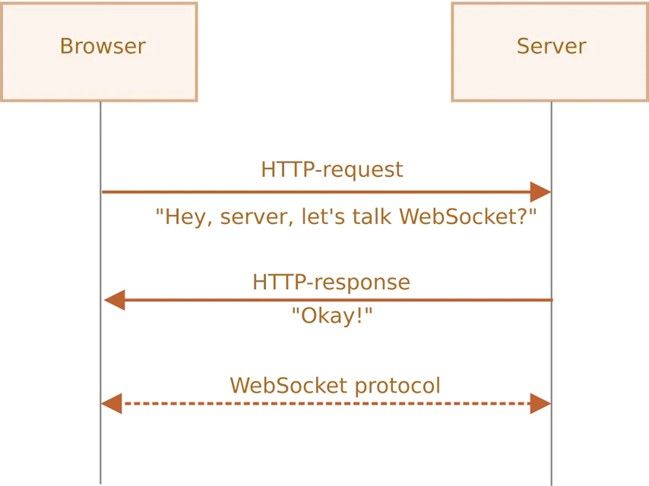
Although WebSockets enable persistent communication, they actually begin as a standard HTTP request. When the client wants to establish a WebSocket connection, it sends a request asking the server to upgrade the protocol.
During this process, the client includes specific headers that indicate a WebSocket upgrade request. The server then verifies that the request is valid and that it supports the WebSocket protocol. If everything checks out, the server responds with a special status code indicating that the connection will switch protocols.
At that moment, the connection transitions from HTTP to the WebSocket protocol. Unlike normal HTTP communication, the connection does not close after a response is sent. Instead, it remains open so that both the client and server can exchange messages freely.
Once the connection is established, data is transmitted through lightweight frames. The protocol also includes control frames, such as ping and pong messages, which help keep the connection alive and ensure that both sides are still connected.
7. Architecture in Real Systems
Simple examples of WebSockets often show a client connecting directly to a single server. While this works for small applications, real-world systems require a more scalable architecture.
In production environments, WebSocket connections are typically distributed across multiple servers. Load balancers distribute incoming connections to ensure that no single server becomes overwhelmed. Behind these servers, message brokers or event systems are often used to synchronize data between different services.
For example, if one server receives a message from a client, that message might be published to a message broker such as Redis or Kafka. Other servers subscribed to that message can then broadcast updates to their connected clients. This architecture allows large applications to handle thousands or even millions of simultaneous connections while maintaining real-time performance.
Designing such systems requires careful planning around connection management, scaling strategies, and event distribution.
8. Implementing WebSockets in React
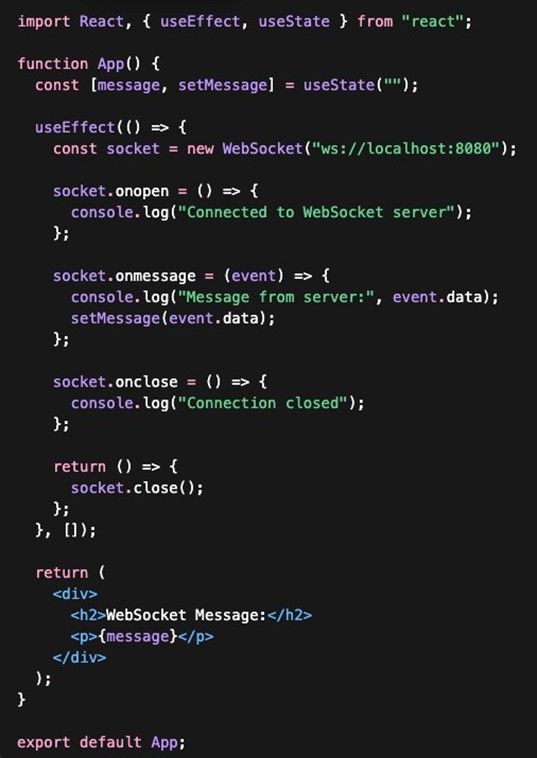
Modern browsers provide a built-in WebSocket API, which means frontend frameworks like React can use WebSockets without requiring additional libraries.
In a typical React application, a WebSocket connection is created when a component mounts. The application listens for events such as connection open, incoming messages, errors, and connection closure. Whenever a message is received, the React component can update its state and re-render the interface accordingly.
Many teams also use libraries such as Socket.IO to simplify implementation. These libraries provide additional features like automatic reconnection, event-based messaging, and fallback communication methods if WebSockets are unavailable.
Here is a simple example:
9. Production Concerns
While WebSockets provide powerful capabilities, deploying them in production introduces new challenges.
One major concern is connection management. Since WebSocket connections remain open, servers must maintain many simultaneous connections. Each connection consumes memory and resources, which means infrastructure must be designed to handle large volumes of persistent connections.
Another challenge is reliability. Network interruptions, mobile connectivity issues, or server restarts can cause connections to drop. Applications must therefore implement reconnection strategies and handle missed messages gracefully.
Security is also important. Systems must validate incoming messages, authenticate users, and protect against malicious traffic or abuse. Without proper safeguards, real-time communication systems can become vulnerable to attacks.
For these reasons, monitoring and observability are essential when running WebSockets in production environments.
10. When NOT to Use WebSockets
Although WebSockets are powerful, they are not always the best choice. Many applications function perfectly well using traditional HTTP APIs.
If an application only needs occasional updates, maintaining a persistent connection may add unnecessary complexity. In such cases, simple API requests or periodic polling may be easier to implement and maintain.
WebSockets also require more sophisticated infrastructure to scale effectively. Applications with limited server resources or minimal real-time requirements may find the added operational overhead unnecessary.
Choosing the right communication method should always depend on the specific needs of the system being built.
11. Conclusion
WebSockets play an important role in enabling real-time communication on the modern web. By allowing clients and servers to maintain a persistent, bidirectional connection, they make it possible to deliver instant updates without repeated HTTP requests.
This capability has become essential for many modern applications, from chat platforms and collaborative tools to live dashboards and online gaming systems. At the same time, WebSockets introduce architectural and operational challenges that developers must consider carefully.
When used appropriately and supported by a well-designed backend infrastructure, WebSockets provide a powerful foundation for building responsive, real-time user experiences.
About the Author

Mayank Matkar
Mayank Matkar is a frontend developer passionate about crafting clean, performant interfaces with React and modern web technologies.
About the Author
Mayank Matkar
Mayank Matkar is a frontend developer passionate about crafting clean, performant interfaces with React and modern web technologies.