
TOON: The Future of Structured Data for APIs and AI Systems
TOON: The Future of Structured Data for APIs and AI Systems
Introduction
TOON (Typed Object-Oriented Notation) is a strongly typed, schema-driven data format designed to eliminate ambiguity in data exchange. It enforces strict structure, predictable behavior, and reliable validation across all services. In this context, TOON refers to a modern, schema-bound format designed for today’s automation needs, including LLM tool calling and machine-to-machine communication. While token-based notations have existed historically in networking and embedded systems, TOON applies the idea specifically to ensure correctness in scalable and AI-driven systems.
Why Structured Data Matters
Modern applications depend on constant data exchange. One system creates data; another interprets and acts on it. That only works when the data is always strictly valid and consistent.
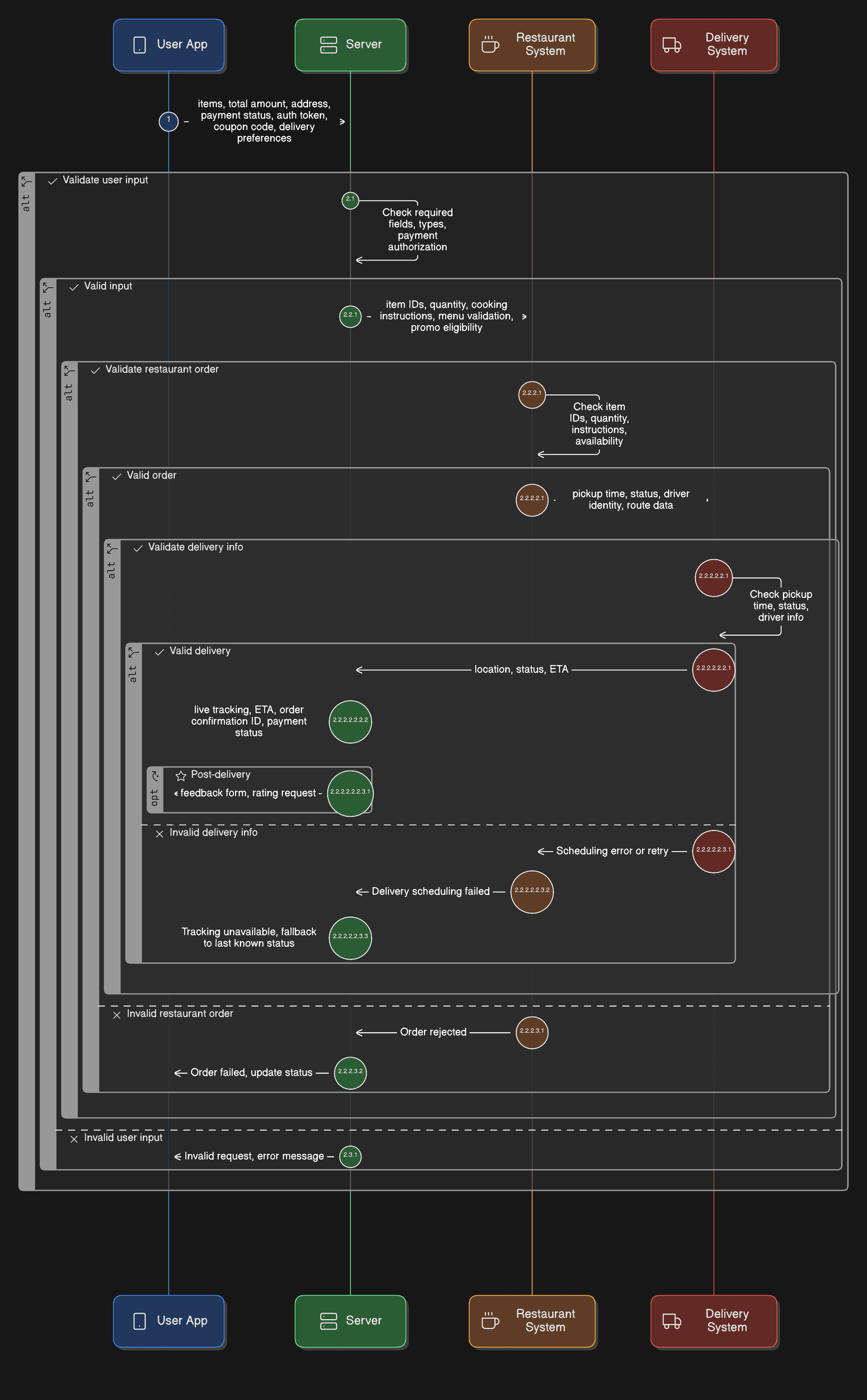
Take a common scenario like ordering food:
Your app → Server: items, total amount, address, payment status
Server → Restaurant: item IDs, quantity, instructions
Restaurant → Delivery: pickup time and status
Server → Your app: live tracking and ETA
If even one field comes in as the wrong type (for example, "500" instead of 500), it can cause workflow failures, incorrect routing, or silent errors that degrade user experience.
As systems became more distributed and complex, JSON’s flexibility turned into a liability.
This challenge led to the rise of TOON.
What Is TOON?
TOON is a typed object notation that enforces:
- Predictable data shapes
- Strict type safety
- Explicit field definitions
- Schema-driven validation
- Consistent interpretation across environments
JSON says: “Send whatever fields you want. I’ll try my best.”
TOON says: “Send exactly what is defined. Nothing more. Nothing less.”
This shift from flexible to structured is why TOON adoption is accelerating in large-scale systems.
How TOON Looks in Practice
type UserProfile {
  userId: int
  name: string
  isActive: bool
  scores: list
  address: Address
}

type Address {
  street: string
  city: string
  pincode: int
}
Every field has a clear type.
No silent coercions. No missing fields. No surprises.
Supported Data Types in TOON
TOON provides a rich, strongly typed set of data types that cover almost all modern application needs. Unlike JSON—which only has 6 loose types—TOON supports explicit, unambiguous types built for machine correctness.
Primitive Types
- int – whole numbers
- float / double – decimal values
- string – textual data
- bool – true/false
- bytes – binary content (images, signatures, encrypted blocks)
Composite Types
- list
– ordered list of any type - map<string, T> – key-value object with strict type rules
- set
– unique unordered collection - tuple<T1, T2…> – fixed structure with multiple typed values
Custom Object Types
- type Blocks (like classes)
type User {
	  id: int
	  name: string
	  roles: list
	}
Why JSON Fails at Scale
- Too flexible → wrong field types allowed
- No strong typing → manual validation required
- Formatting varies by language → runtime inconsistencies
- Poor evolution tracking → documentation easily drifts
- Silent failures → debugging is expensive
TOON’s core philosophy:
Structure first, interpretation later.
How TOON Works
1. Schema-First Contracts enforced before runtime.
2. Strict Type Enforcement Data must match the declared schema.
3. Built-in Validation Prevents malformed or incomplete payloads.
4. Language-Agnostic Behavior Identical interpretation in any tech stack.
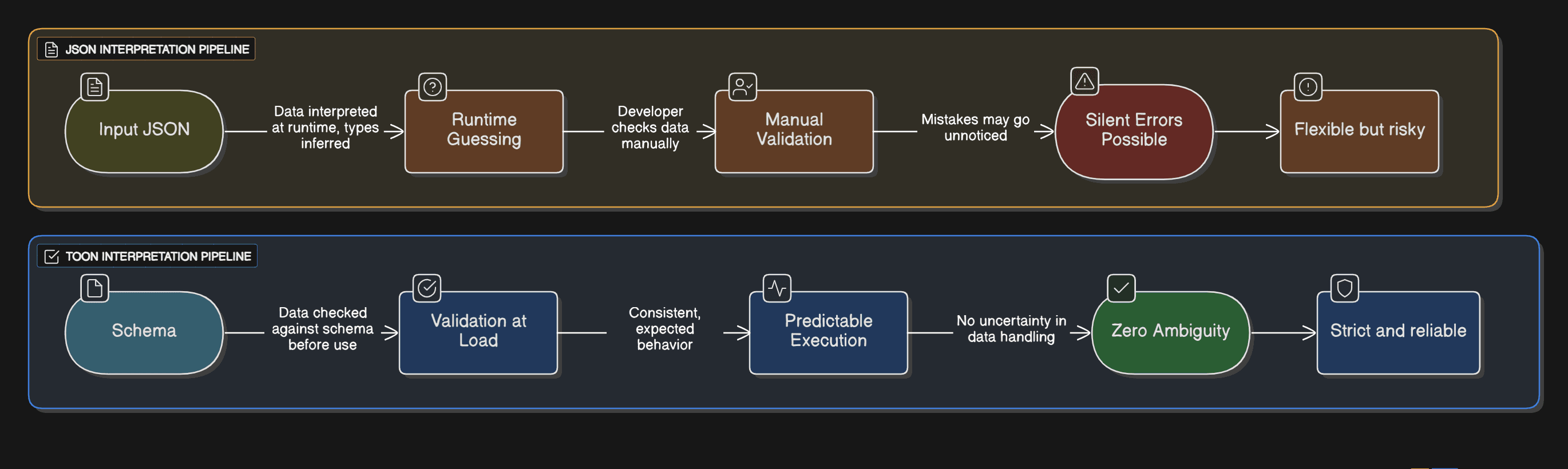
JSON ↔ TOON Conversion: How It Works
Just like JSON to String and String to JSON conversion is standardized across all languages, TOON also follows a predictable, schema-driven conversion process.
1. TOON to String Conversion
TOON structures are compiled into:
- a canonical text format, or
- a compact binary format (depending on implementation)
Because the schema defines every field and type, conversion is guaranteed to be type-safe and lossless.
2. String to TOON Conversion
When converting text back to TOON:
- the parser loads the TOON schema
- validates each incoming field
- checks type correctness
- rejects malformed or mismatched data instantly
No silent coercions. No auto-conversion like "500" → 500. No guessing.
3. Schema as the Decoder
JSON relies on runtime code to interpret structure.
TOON relies on the schema itself, which acts as the decoder and validation engine.
4. Tooling Support
Modern toolchains provide:
- automatic TOON serializers/deserializers
- code-generation for languages like Java, TypeScript, Python
- IDE validation
- linting and debugging tools
So the conversion pipeline becomes:
TOON object → Serializer → TOON string/binary
TOON string → Parser → Validated TOON object
Exactly like JSON today —
but with precise types and zero ambiguity.
TOON vs JSON: A Quick Comparison
| Aspect | JSON | TOON |
|---|---|---|
| Data strictness | Very permissive | Strongly typed |
| Validation | Mostly manual | Automatically enforced |
| Language behavior | Can differ by environment | Guaranteed consistent |
| Error detection | Late (runtime) | Early (load/compile time) |
| Versioning | Informal and risky | Schema-driven evolution |
Example JSON (looks fine, actually wrong)
{
  "amount": "500",
  "isActive": "true",
  "items": ["12", "34", 56]
}
Example TOON (strict and safe)
amount: int
isActive: bool
items: list
TOON in LLMs:
LLMs (like GPT, Claude, Llama) do not internally think in typed structures. They operate on language tokens. However, their interactions with tools, APIs, and autonomous workflows must be machine-correct.
This is where JSON failed:
- models output malformed JSON
- missing quotes or trailing commas break automation
- hallucinations add extra fields
- mixed types cause runtime errors
LLMs + JSON = unstable automation
Why TOON excels with AI workflows
1. Strong Typing Models output known types only.
2. Zero Ambiguity No guessing of structure.
3. Machine-Reliable Output Valid responses even when hallucination pressure exists.
4. Stable Tool Calling Used for function execution, workflow orchestration, agent actions.
5. Multi-model Consistency One schema → many model providers → no integration headaches.
Correctness > Creativity in automated systems.
This is why TOON is rapidly becoming the default for:
- AI agents
- API orchestration
- Autonomous workflows
- Multi-step reasoning
- Machine-to-machine communication
TOON Drawbacks
TOON has trade-offs teams must recognize:
- Less flexible during rapid prototyping
- Requires deeper understanding of schema design
- Overkill for small/simple projects
- Schema updates require coordination across systems
- Tooling ecosystem is newer and still growing
These are acceptable limitations in high-scale environments where correctness is critical.
The Future of Data Formats
-
Industry Shift: Flexibility → Structure Typed formats like TypeScript and TOON prevent bugs upfront.
-
Built for Distributed Systems Ambiguous data has exponential negative impact across microservices.
-
Foundation for Next-Generation APIs and AI Systems As digital ecosystems scale, loose formats like JSON cannot keep up.
TOON creates the guardrails needed for reliable growth.
Conclusion
We built modern software on JSON because it was fast, familiar, and forgiving. We now operate systems where correctness, scale, and automation matter more than flexibility.
TOON is not just another data format.
It represents a shift toward discipline, consistency, and safe interoperability — especially with the rise of AI-driven automation.
Teams that adopt TOON early position themselves for a more stable and scalable future.
About the Author

Nagendra Sharma
Nagendra Sharma is a backend developer at Infominez, skilled in Spring Boot and scalable APIs. He focuses on structured data formats, automation, and modern technologies, and writes about backend engineering and emerging tech trends.
About the Author
Nagendra Sharma
Nagendra Sharma is a backend developer at Infominez, skilled in Spring Boot and scalable APIs. He focuses on structured data formats, automation, and modern technologies, and writes about backend engineering and emerging tech trends.