
Stop Drawing Blueprints: Why Enterprise Architecture Must Become “Gardening” in the AI Era
Stop Drawing Blueprints: Why Enterprise Architecture Must Become “Gardening” in the AI Era
From Static Design to Living Systems
For decades, Enterprise Architecture followed a familiar playbook.
Architects behaved like city planners
-
designing rigid blueprints
-
laying down fixed integration highways and constructing monolithic application blocks like ERP, CRM, and Data Warehouses.
The goals were clear: stability, predictability, and control.
That model worked—until AI changed the rules of physics.
Generative AI has pushed us from a deterministic world
(If A happens, then B will follow)
into a probabilistic world
(Given A, B is the most likely outcome).
In this new reality, static architecture isn’t just inefficient, it’s risky.
You cannot architect a Large Language Model the way you build a database. You cannot integrate an autonomous agent the way you integrate a REST API.
If enterprise architecture continues to optimize only for stability, it will rapidly optimize itself out of relevance.
The future of Enterprise Architecture is no longer construction. It is cultivation.
Welcome to the era of Architect as Gardener.
1. The New Data Foundation: Mesh on Fabric
For years, enterprises argued endlessly:
- “Centralize everything” → Data Lakes
- “Decentralize everything” → Data Mesh
AI ends this debate.
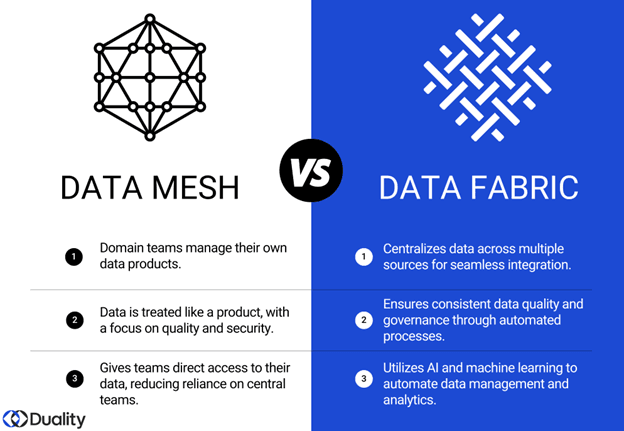
The winning model for the AI era is Mesh on Fabric—a pragmatic hybrid that combines technical unification with domain ownership.
What This Actually Means
Data Fabric (Technology Layer)
An intelligent, automated integration layer that connects all enterprise data sources—cloud, on-prem, SaaS, and legacy—without physically moving data.
It provides real-time access, metadata awareness, and semantic understanding.
Data Mesh (Operating Model)
Each business domain—Sales, Finance, Marketing—owns its data as a product.
This enforces accountability for data quality, definitions, freshness, and trust.
Why AI Depends on This
AI models are stateless.
They can reason brilliantly—but they have no native memory of your business.
If your enterprise context is fragmented, inconsistent, or poorly governed, AI won’t just fail—it will confidently produce the wrong answer.
Mesh on Fabric ensures that AI systems are grounded in authoritative, contextual truth, not stitched-together guesses.
2. The Real Disruption: The Agentic Mesh
This is where enterprise software fundamentally changes.
Traditional integration is workflow-centric:
“When an order is placed → call inventory → if successful → send email.”
These pipelines are brittle.
One API change, one system outage—and everything collapses.
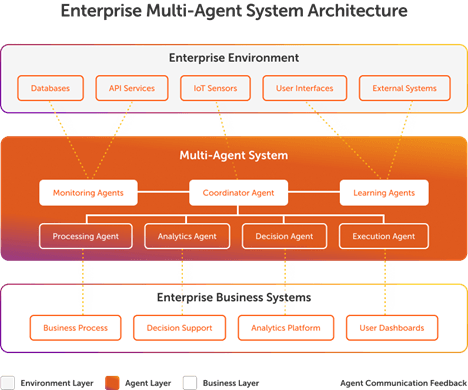
Enter the Agentic Mesh
Instead of writing rigid workflows, we deploy autonomous agents.
You don’t script steps.
You define goals, policies, and tools.
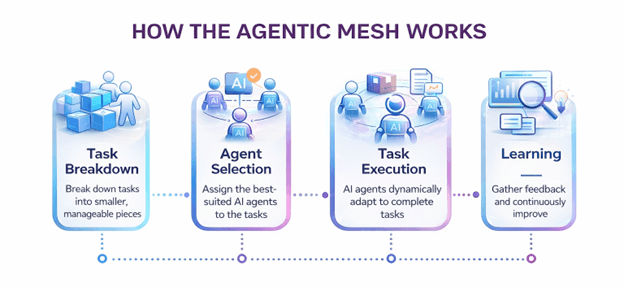
A Fulfillment Agent doesn’t follow instructions—it reasons:
“Primary warehouse is empty.
Checking secondary location.
Stock available.
Booking shipment and notifying customer.”
The agent navigates complexity, adapts to failures, and selects the optimal path dynamically.
Architectural Shift
-
From workflows to intent
-
From control logic to guardrails
-
From integration pipelines to collaborating agents
Enterprise Architecture becomes less about orchestration and more about constraint design, trust boundaries, and outcome governance.
3. The Hidden Reality: The Economics of Thinking
There’s an uncomfortable truth enterprises are beginning to realize:
AI is a utility, just like electricity.
And just like electricity, uncontrolled usage leads to runaway costs.
As we move from traditional software (fixed cost) to inference-driven systems (variable cost), architecture directly impacts P&L.
New Architectural Responsibilities
-
Context Optimization : Every unnecessary token sent to a large model costs money.
-
Model Routing : Not every task needs a top-tier reasoning model. Simple classification, extraction, and routing should use smaller, cheaper models.
-
AI Factories : Enterprises must design platforms specifically optimized for the cost, latency, and reliability of “thinking at scale.”
In the AI era, architecture decisions are financial decisions.
The New Role of the Enterprise Architect
The Enterprise Architect is no longer a diagram producer or framework custodian.
They are Digital Ecosystem Strategists.
Their mandate now includes:
-
Designing data ecosystems that give AI memory
-
Governing autonomous agents instead of hard-coded flows
-
Managing probabilistic outcomes, not deterministic paths
-
Balancing innovation velocity with economic sustainability
What Needs to Change—Now
-
Stop creating static 5-year roadmaps
-
Start investing in data fabric foundations
-
Start piloting agent-based systems in real workflows
-
Start governing behavior and probability, not just access and APIs
Final Thought
The tools have changed.
The economics have changed.
The physics of software have changed.
Enterprise Architecture must change with them.
The future belongs not to those who draw better blueprints—but to those who know how to grow resilient, adaptive systems.
About the Author

Sanjay Gawatiya
Sanjay Gawatiya is a Technical Lead at Infominez, specializing in enterprise architecture and AI-driven systems. He writes about modern, adaptive architectures, agent-based systems, and the future of enterprise technology in the AI era.
About the Author
Sanjay Gawatiya
Sanjay Gawatiya is a Technical Lead at Infominez, specializing in enterprise architecture and AI-driven systems. He writes about modern, adaptive architectures, agent-based systems, and the future of enterprise technology in the AI era.