Soulbound NFTs: Building Identity, Trust, and Reputation in Web3
Soulbound NFTs: Building Identity, Trust, and Reputation in Web3
Introduction
NFTs changed how we think about digital ownership. They made digital assets transferable, tradable, and permissionless. Art, music, gaming assets, and virtual land can now be freely owned and exchanged on the blockchain.
However, not everything in the digital world should be transferable.
Credentials, reputation, memberships, and identity are personal by nature. These elements are meant to stay with an individual, not circulate in markets like financial assets.
This gap is where Soulbound NFTs emerge as a critical building block for Web3.
What Are Soulbound NFTs?
Soulbound NFTs (SBTs) are non-transferable blockchain tokens that are permanently linked to a specific wallet address, often referred to as a “soul.” Once issued, they cannot be transferred, sold, or delegated.
Unlike traditional NFTs (ERC-721 or ERC-1155), Soulbound NFTs:
- Cannot be transferred between wallets
- Cannot be sold on marketplaces
- Cannot be approved for delegation
- Represent identity, credentials, reputation, or membership
Their purpose is not speculation or profit, but verifiable digital proof that belongs to a person or entity.
Origin of the Soulbound Concept
The term “soulbound” originates from gaming, where certain items—once acquired—cannot be traded or passed to another player. These items represent achievements or status rather than market value.
This concept was later adapted to blockchain by Vitalik Buterin and collaborators in discussions around Decentralized Society (DeSoc). The idea was to introduce non-transferable social primitives—such as identity and reputation—into Web3, alongside financial primitives.
In this model:
- Wallets act as identity anchors
- Soulbound NFTs act as verifiable attestations
Why Do We Need Soulbound NFTs?
Transferable NFTs work well for assets, but they fail when applied to identity-related use cases.
Consider the following:
- A university degree should not be sellable
- DAO reputation should not be transferable
- KYC verification should not be tradable
- Governance rights should reflect participation, not wealth
If these were transferable, trust would collapse.
Soulbound NFTs solve this by ensuring that credentials and achievements remain bound to the original wallet, preserving authenticity and credibility across Web3 systems.
NFTs vs Soulbound NFTs
| Feature | NFTs | Soulbound NFTs |
|---|---|---|
| Transferable | Yes | No |
| Tradable | Yes | No |
| Speculative | Often | No |
| Identity-based | No | Yes |
| Reputation-focused | No | Yes |
Standards and Implementation Approaches
There is currently no single finalized ERC standard for Soulbound NFTs. Instead, multiple approaches are used in practice, as given in the image below.
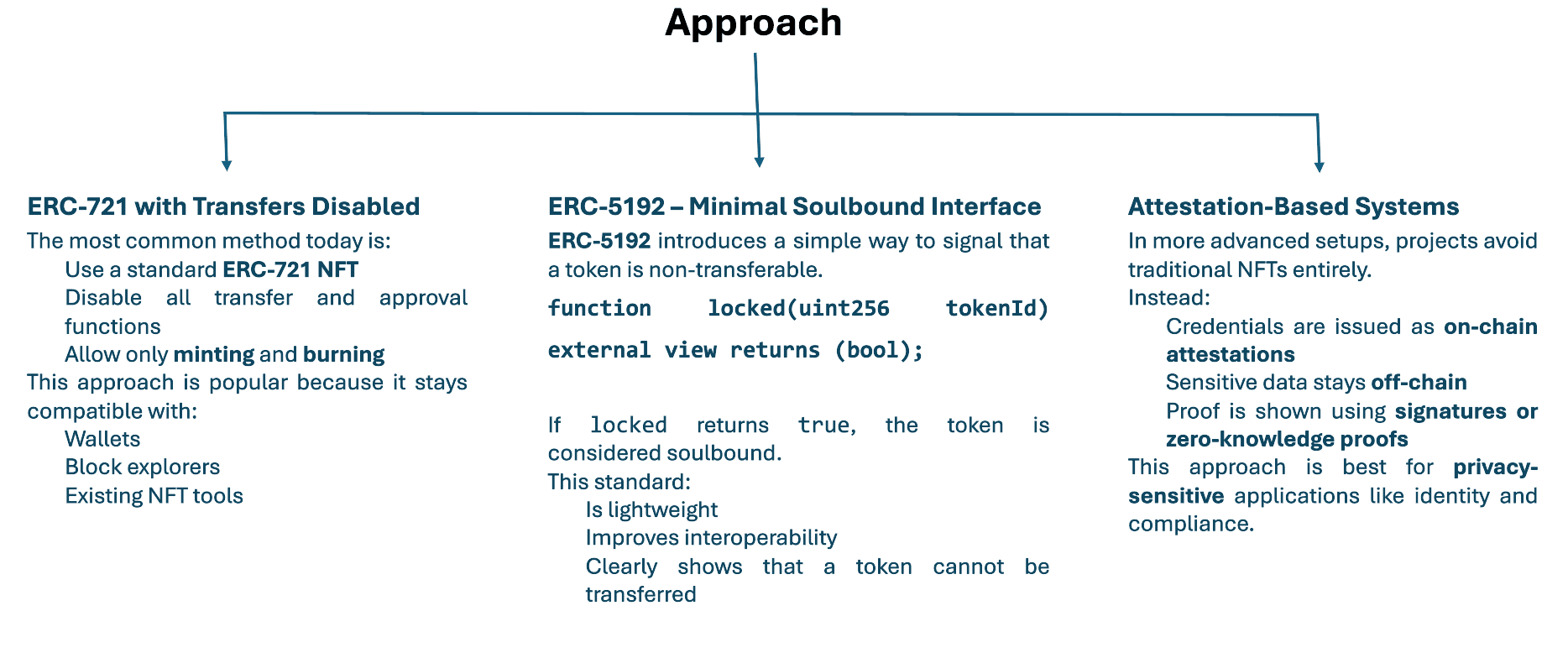
Each approach balances compatibility, privacy, and governance differently.
Real-World Use Cases
1. Digital Identity and Credentials
- University degrees
- Professional certifications
- KYC and compliance proofs
2. DAO Reputation
DAOs rely on participation and contribution rather than hierarchy.
- Voting eligibility
- Contribution history
- Governance access levels
3. Web3 Gaming
Soulbound NFTs are often used for:
- Player achievements
- Status indicators
- Non-tradable rewards
4. Access Control
- Event and conference passes
- Community memberships
- Enterprise permissions
Governance and Authority Considerations
A critical question in Soulbound NFT systems is who controls issuance and revocation.
Poor governance design can lead to:
- Issuer abuse
- Unfair revocation
- Permanent negative labelling
Best practices include:
- Multi-signature or DAO-controlled issuers
- Transparent revocation rules
- Appeal and correction mechanisms
Legal and Ethical Considerations
Identity is not only a technical challenge—it is also a legal and ethical one.
Key concerns include:
- Right to privacy
- Right to correction
- Right to be forgotten
- Regulatory compliance
To reduce legal risk:
- Avoid storing personal data on-chain
- Use hashes or off-chain references
- Enable revocation and expiration
Ethically, Soulbound NFTs should empower users, not trap them in permanent digital labels.
How Soulbound NFTs Are Implemented (Developer View)
A typical Soulbound NFT contract:
- Inherits from ERC-721
- Disables transfers and approvals
- Allows controlled minting and burning
Core lifecycle:
Mint → Hold → (Optional Burn)
Developers must decide:
- Who can mint?
- Can tokens be revoked?
- Is metadata mutable?
- How is user privacy protected?
Benefits
- Prevents credential fraud
- Enables trust-based systems
- Improves DAO governance
- Aligns incentives with behavior
Soulbound NFTs introduce non-financial identity primitives that Web3 critically needs.
Challenges and Risks
Privacy Risks
Mitigation:
- Hashed metadata
- Zero-knowledge proofs
- Off-chain attestations
Issuance Errors
Mitigation:
- Revocation mechanisms
- Time-limited credentials
Wallet Loss
Mitigation:
- Social recovery
- Account abstraction
- Identity registries
The Future of Soulbound NFTs
Soulbound NFTs will play a foundational role in:
- Decentralized identity (DID)
- Web3 resumes
- Reputation-based finance
- Trust-driven governance
Future developments will likely include:
- Clear ERC standardization
- ZK-native identity proofs
- Cross-chain reputation systems
- Legal recognition of on-chain credentials
Final Thoughts
Soulbound NFTs represent a shift in Web3—from “what you own” to “who you are.”
They will not replace traditional NFTs, but they will complement them by enabling identity, trust, and accountability at the protocol level.
For developers and organizations, Soulbound NFTs are not just a feature—they represent a new design paradigm for human-centric Web3 systems.
About the Author

Dr. Kapil K. Kushwah
Dr. Kapil K. Kushwah is a blockchain developer with hands-on experience in building decentralized applications and smart contract–based systems. He has worked on multiple blockchain projects and specializes in designing secure, scalable Web3 solutions. His work focuses on applying blockchain technology to real-world identity, trust, and governance use cases.
About the Author
Dr. Kapil K. Kushwah
Dr. Kapil K. Kushwah is a blockchain developer with hands-on experience in building decentralized applications and smart contract–based systems. He has worked on multiple blockchain projects and specializes in designing secure, scalable Web3 solutions. His work focuses on applying blockchain technology to real-world identity, trust, and governance use cases.