
The Role of Secure Application Design in Meeting Fintech Regulations
The Role of Secure Application Design in Meeting Fintech Regulations
Introduction
Fintech applications operate at the intersection of money, data, and trust. Unlike traditional software, a fintech app is not just a product—it is a regulated financial system. Every transaction, every API call, and every data field is subject to strict compliance rules such as PCI DSS, GDPR, SOC 2, ISO 27001, RBI guidelines, and AML/KYC regulations.
In this environment, security cannot be an afterthought or a patch applied before launch. Secure Application Design is the foundation that enables fintech products to meet regulatory requirements by design, not by force.
This blog explores how secure design principles directly support regulatory compliance in fintech systems—and why design-level security is more effective than reactive controls.
Why Fintech Regulations Exist
Financial regulations are not meant to slow innovation. They exist to protect:
-
Customer funds
-
Sensitive personal data
-
Financial system stability
-
Market integrity
-
Trust in digital payments
Common regulatory concerns include:
-
Unauthorized access to accounts
-
Data leaks and identity theft
-
Fraudulent transactions
-
Inadequate audit trails
-
Weak authentication mechanisms
If these risks are not addressed at the design stage, no amount of monitoring or compliance paperwork can fully compensate later.
Secure Application Design: What It Really Means
Secure application design is not just about encryption or firewalls.
It means architecting the system so that security and compliance are built into every layer, including:
-
Data models
-
APIs
-
Authentication flows
-
Authorization logic
-
Logging and auditing
-
Error handling
-
Infrastructure boundaries
In fintech, secure design answers regulatory questions before they are asked.
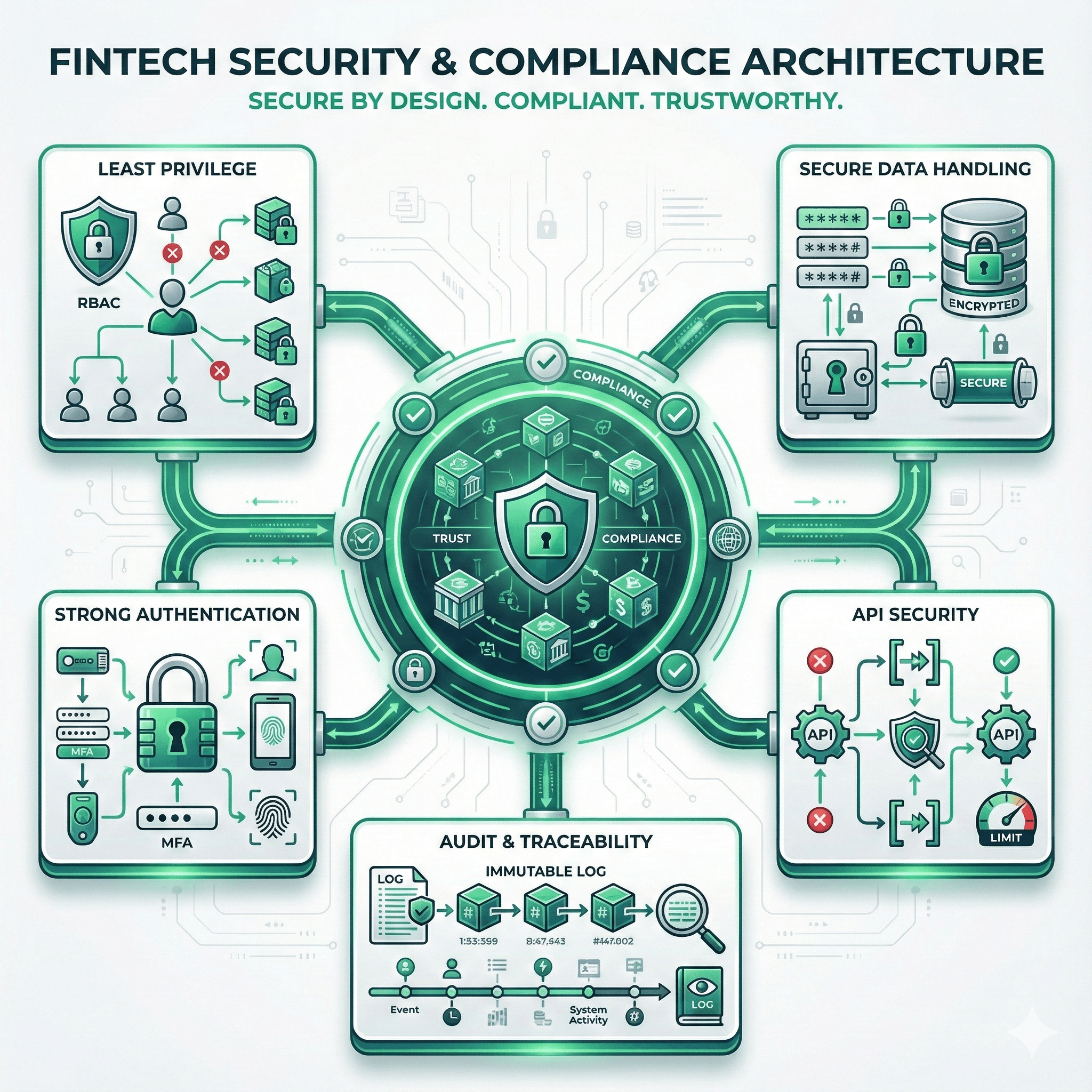
Core Security Principles That Enable Compliance
1. Least Privilege by Design
Regulations demand strict access control.
Secure design ensures:
-
Users only access what they are authorized to
-
Internal services have minimal permissions
-
Admin privileges are tightly scoped
Regulatory Impact
-
Meets SOC 2 and ISO access control requirements
-
Reduces insider threat risk
-
Prevents privilege escalation attacks
2. Strong Authentication and Identity Verification
Fintech regulations require robust user identity validation.
Secure design includes:
-
Multi-factor authentication (MFA)
-
Secure session handling
-
Token-based authentication (short-lived, revocable)
-
Device and behavioral signals
Regulatory Impact
-
Supports KYC and AML compliance
-
Reduces account takeover incidents
-
Aligns with RBI and PSD2 authentication standards
3. Secure Data Handling and Storage
Financial data is among the most sensitive data categories.
Secure design enforces:
-
Encryption at rest and in transit
-
Secure key management (HSMs, vaults)
-
Data classification and segregation
-
Masking of sensitive fields (PAN, card numbers)
Regulatory Impact
-
Meets PCI DSS encryption mandates
-
Aligns with GDPR data protection principles
-
Reduces breach impact and reporting liability
4. API Security as a First-Class Citizen
Modern fintech systems are API-driven.
Secure design includes:
-
Strict input validation
-
Schema-based request/response contracts
-
Rate limiting and throttling
-
Strong authentication between services
-
Zero-trust API communication
Regulatory Impact
-
Prevents data leakage via APIs
-
Ensures traceability of financial operations
-
Reduces risk of injections and abuse attacks
5. Auditability and Traceability by Default
Regulators require visibility.
Secure design ensures:
-
Immutable audit logs
-
Traceable transaction flows
-
User and system action tracking
-
Tamper-resistant logging systems
Regulatory Impact
-
Simplifies audits and compliance reporting
-
Meets SOC 2 logging requirements
-
Enables forensic analysis after incidents
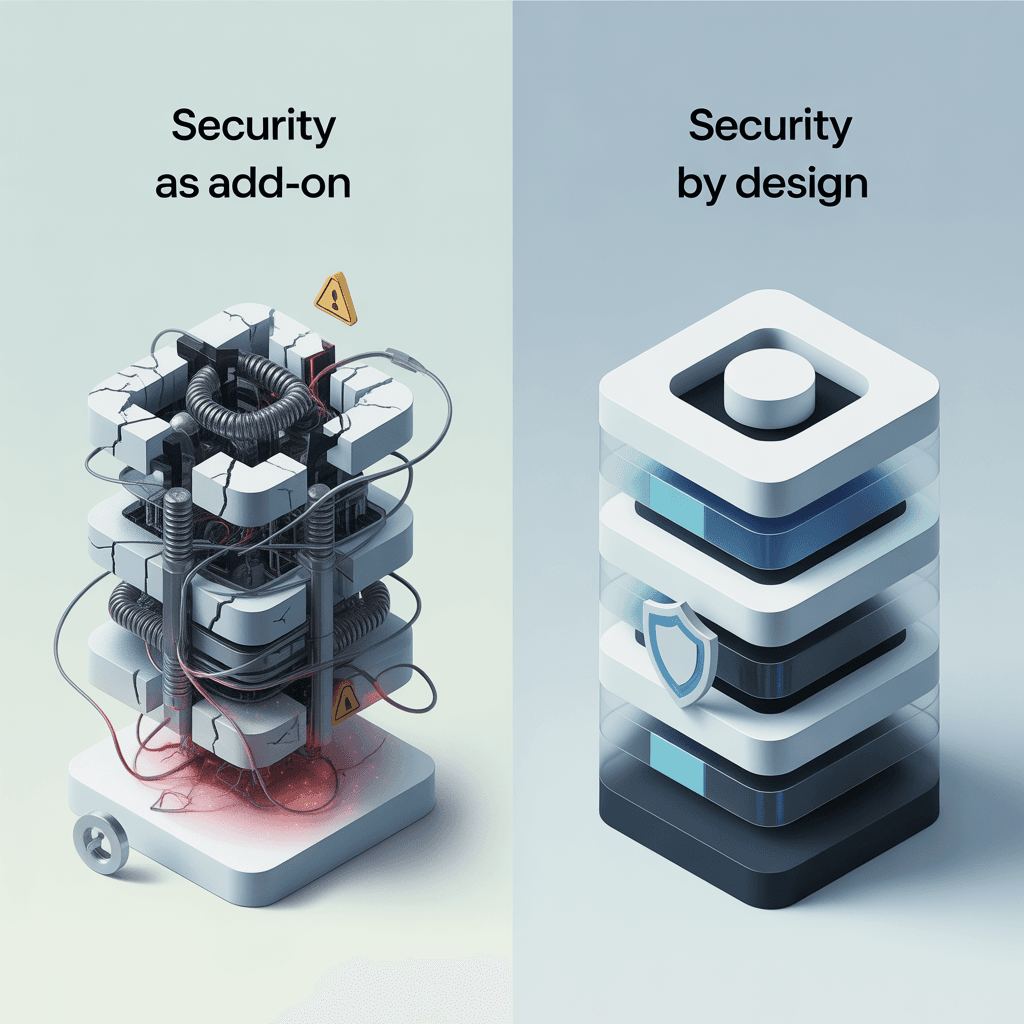
Secure Design vs Security Add-Ons
Many fintech failures happen because security is added later, not designed upfront.
| Approach | Outcome |
|---|---|
| Security as Add-On | Complex, fragile, audit-heavy |
| Security by Design | Clean, scalable, compliance-ready |
When security is embedded in design:
-
Compliance becomes a side-effect, not a burden
-
Fewer last-minute audit fixes
-
Lower long-term security costs
Real-World Example: Payment Processing Flow
A securely designed payment system enforces:
-
Input validation before processing
-
Authorization before fund movement
-
Idempotency to prevent double charges
-
Logging of every state change
-
Reconciliation-ready data models
This directly supports:
-
PCI DSS transaction integrity
-
Fraud detection requirements
-
Regulatory dispute handling
Common Compliance Failures Caused by Poor Design
-
Hardcoded secrets and credentials
-
Over-permissive APIs
-
Inconsistent data validation
-
Weak role separation
-
Missing audit logs
-
Insecure third-party integrations
Most of these are design flaws, not tooling issues.
Secure Design as a Competitive Advantage
Fintech startups often view compliance as a cost.
In reality, secure application design:
-
Accelerates regulatory approvals
-
Builds trust with banks and partners
-
Reduces breach-related downtime
-
Improves customer confidence
-
Enables faster geographic expansion
Well-designed systems scale with regulations instead of breaking under them.
The Future of Fintech Security
The fintech industry is moving toward:
-
Security-by-design frameworks
-
Zero-trust architectures
-
Schema-driven APIs
-
Automated compliance validation
-
Continuous risk monitoring
Regulators are increasingly evaluating architecture quality, not just policies.
Conclusion
In fintech, compliance is not achieved through documentation alone. It is achieved through secure application design.
When systems are designed with:
-
Clear trust boundaries
-
Strong identity controls
-
Secure data flows
-
Built-in auditability
Regulations stop being obstacles and start becoming natural outcomes of good engineering.
Secure design is no longer optional in fintech—it is the only sustainable way to build compliant, scalable, and trustworthy financial products.
About the Author

Nagendra Sharma
Nagendra Sharma is a backend developer at Infominez, skilled in Spring Boot and scalable APIs. He focuses on structured data formats, automation, and modern technologies, and writes about backend engineering and emerging tech trends.
About the Author
Nagendra Sharma
Nagendra Sharma is a backend developer at Infominez, skilled in Spring Boot and scalable APIs. He focuses on structured data formats, automation, and modern technologies, and writes about backend engineering and emerging tech trends.