
State Management in React: Redux vs Zustand
State Management in React: Redux vs Zustand
Introduction
State management is one of the most important concepts in frontend development, especially in modern React applications. As applications grow in size and complexity, managing shared state across multiple components becomes challenging. While React provides built-in tools like useState and useContext, they often fall short for large-scale applications.
To address these challenges, external state management libraries are commonly used. In this article, we’ll explore two popular state management libraries in the React ecosystem: Redux and Zustand. We’ll understand why state management is needed, how each library works, and when to choose one over the other.
What is State Management?
State refers to the data that determines how a UI behaves and what it displays at any given time. Examples include:
- User authentication status
- Theme (light/dark mode)
- Form data
- API response data
State management is the practice of storing, updating, and sharing this state efficiently across an application.
Why Not Just Use React State?
React’s built-in state management tools are great for small applications, but they have limitations:
- Prop drilling: Passing state through multiple component layers
- Complex logic: Hard to manage side effects and async flows
- Scalability issues: Difficult to maintain as the app grows
This is where libraries like Redux and Zustand come in.
Redux
What is Redux?
Redux is a predictable state container for JavaScript applications. It follows strict rules and enforces unidirectional data flow, making state changes predictable and easy to debug. Redux is commonly used with React via React-Redux.
Core Concepts of Redux
- Store: A single global object that holds the entire application state
- Actions: Plain JavaScript objects that describe what happened
- Reducers: Pure functions that determine how the state changes based on actions
- Dispatch: The method used to send actions to the store
Redux Flow
- UI dispatches an action
- Reducer receives the action
- Reducer returns a New State
- Store updates the state
- UI re-renders
Example: Redux Counter
// actions.js
export const increment = () => ({ type: 'INCREMENT' });

// reducer.js
const initialState = { count: 0 };

export function counterReducer(state = initialState, action) {
switch (action.type) {
case 'INCREMENT':
return { count: state.count + 1 };
default:
return state;
}}
Pros of Redux
- Predictable and structured
- Excellent DevTools and debugging
- Strong ecosystem and community
- Ideal for large, complex applications
Cons of Redux
- Boilerplate-heavy
- Steep learning curve
- Requires multiple files and concepts
Zustand
What is Zustand?
Zustand is a lightweight and minimalistic state management library for React. It uses hooks and avoids boilerplate, making it simple and intuitive. Zustand is built on top of modern React features and focuses on developer experience.
Example of Zustand in which we have integrated ‘get’ API :-
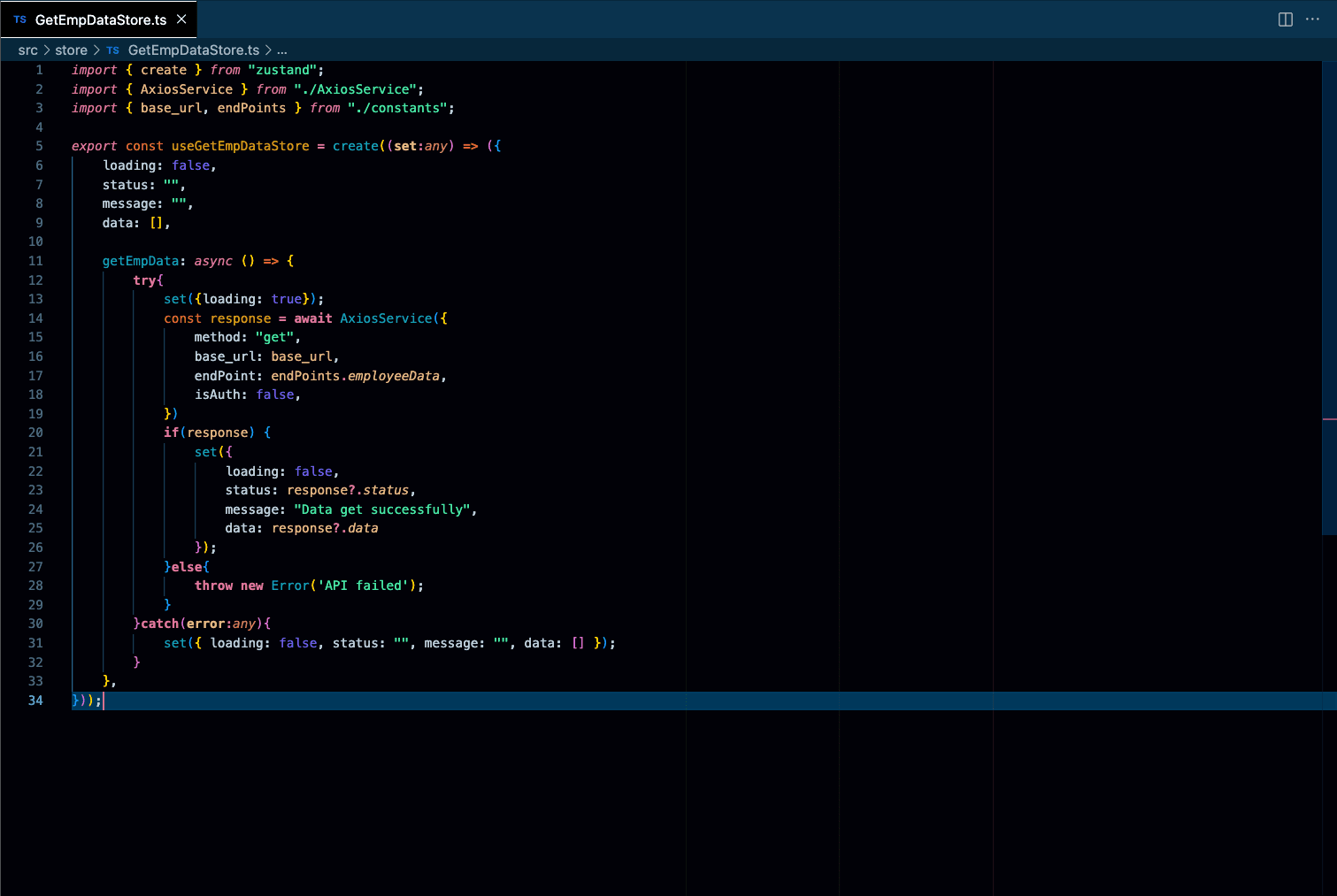
Core Concepts of Zustand
- Store: Created using a hook
- State and actions together: No separation like Redux
- Direct updates: No reducers or action types
Example: Zustand Counter
import { create } from 'zustand';

export const useCounterStore = create((set) => ({
  count: 0,
  increment: () => set((state) => ({ count: state.count + 1 })),
  decrement: () => set((state) => ({ count: state.count - 1 })),
  reset: () => set({ count: 0 }),
}));
Implementing in react component
import React from 'react';
import { useCounterStore } from './counterStore';

function Counter() {
  const { count, increment, decrement, reset } = useCounterStore();

  return (
<div>
<h2>Count: {count}</h2>
<button onClick={increment}>+</button>
<button onClick={decrement}>-</button>
<button onClick={reset}>Reset</button>
</div>
  );
}

export default Counter;
Pros of Zustand
- Minimal boilerplate
- Easy to learn and use
- High performance
- Great for small to medium applications
Cons of Zustand
- Smaller ecosystem than Redux
- Less opinionated (can lead to inconsistency in large teams)
Redux vs Zustand
| Feature | Redux | Zustand |
|---|---|---|
| Boilerplate | High | Very Low |
| Learning Curve | Steep | Easy |
| DevTools | Excellent | Basic |
| Ecosystem | Large | Small |
| Best For | Large apps | Small–medium apps |
When to Choose Redux?
- Large-scale enterprise applications
- Complex state logic
- Need for strict patterns and predictability
- Multiple developers working on the same codebase
When to Choose Zustand?
- Small to medium applications
- Rapid development
- Simple global state needs
- Preference for minimal setup
Persisting State (Persistence Logic)
In many real-world applications, you may want your state to persist across page reloads. Common examples include authentication data, user preferences, or theme settings. Both Redux and Zustand support persistence, but the approach differs.
Persist Logic in Redux
Redux itself does not provide persistence out of the box, but it is commonly implemented using redux-persist.
How redux-persist Works
- Wraps your Redux store
- Saves selected state to storage (localStorage, sessionStorage, AsyncStorage)
- Rehydrates state when the app reloads
Example: Redux Persist Setup
// store.js
import { configureStore } from '@reduxjs/toolkit';
import { persistStore, persistReducer } from 'redux-persist';
import storage from 'redux-persist/lib/storage';
import counterReducer from './counterSlice';

const persistConfig = {
key: 'root',
storage,
};

const persistedReducer = persistReducer(persistConfig, counterReducer);
export const store = configureStore({
reducer: persistedReducer,
});
export const persistor = persistStore(store);

// index.js
import { PersistGate } from 'redux-persist/integration/react';

<PersistGate loading={null} persistor={persistor}>
<App />
</PersistGate>
Pros of Redux Persist
- Fine-grained control over persisted state
- Supports migrations and versioning
- Production-ready for large applications
Cons of Redux Persist
- Additional configuration
- Increases complexity
Persist Logic in Zustand
Zustand provides persistence out of the box via middleware, making it much simpler.
Example: Zustand Persist Middleware
import { create } from 'zustand';
import { persist } from 'zustand/middleware';

const useCounterStore = create(
persist(
(set) => ({
count: 0,
increment: () => set((state) => ({ count: state.count + 1 })),
}),
{
name: 'counter-storage', // key in localStorage
}));
Features of Zustand Persist
- Minimal setup
- Automatic rehydration
- Supports localStorage, sessionStorage, and custom storage
Pros of Zustand Persist
- Extremely simple API
- No extra dependencies
- Ideal for quick persistence needs
Cons of Zustand Persist
- Limited advanced features compared to redux-persist
- Less suited for complex migrations
Redux Persist vs Zustand Persist
| Feature | Redux Persist | Zustand Persist |
|---|---|---|
| Setup Complexity | Medium–High | Very Low |
| Built-in | No | Yes |
| Migrations | Supported | Limited |
| Boilerplate | More | Minimal |
| Best For | Enterprise apps | Small–medium apps |
Conclusion
Both Redux and Zustand support state persistence, but they follow very different philosophies.
- Redux with redux-persist offers powerful, enterprise-grade persistence with more setup.
- Zustand persist middleware provides a clean, lightweight solution with minimal effort.
If your application requires complex persisted state with strict control, Redux is a solid choice. If you prefer simplicity and speed, Zustand with persistence is hard to beat.
Understanding persistence in both libraries will help you build resilient, user-friendly React applications.
Further Reading
- Redux Toolkit Documentation
- Redux-persist Documentation
- Zustand Persist Middleware Documentation
About the Author

Mayank Matkar
Mayank Matkar is a frontend developer passionate about crafting clean, performant interfaces with React and modern web technologies.
About the Author
Mayank Matkar
Mayank Matkar is a frontend developer passionate about crafting clean, performant interfaces with React and modern web technologies.