
Exactly-Once Processing in Financial Systems
Exactly-Once Processing in Financial Systems
Idempotency, Concurrency Control, Outbox Patterns, and Exactly-Once Semantics in Distributed Fintech Systems
Executive Summary
In high-concurrency fintech environments, the integrity of the ledger is the absolute source of truth. As organizations decouple monoliths into microservices, the "Two Generals' Problem" of distributed computing becomes a daily reality. Traditional "At-Least-Once" delivery mechanisms—the default for most message brokers—introduce the risk of double-entry, which is catastrophic for financial audits.
This whitepaper provides an exhaustive technical framework for achieving Exactly-Once Processing (EOP). By layering API-level idempotency, database-level concurrency controls, and event-driven transactional patterns, architects can ensure that no matter how many retries occur across a shaky network, the final state of the financial ledger remains consistent and accurate.
Specifically, this guide dissects the implementation of deterministic idempotency keys, the necessity of optimistic locking to prevent lost updates during concurrent requests, and the Transactional Outbox pattern combined with Change Data Capture (CDC) to eliminate the dual-write problem. Furthermore, it explores how Apache Kafka’s Exactly-Once Semantics (EOS) and the Saga orchestration pattern safely coordinate complex cross-service transactions. Ultimately, adopting this multi-layered defense transforms inherently unpredictable distributed systems into deterministic, audit-ready ecosystems that protect revenue, ensure stringent regulatory compliance, and maintain unshakeable customer trust.
1. The Anatomy of Distributed Failure
In a distributed network, a request exists in a "Superposition of States" when a timeout occurs. The caller does not know if the request failed to reach the server, if the server crashed into mid-execution, or if only the response was lost.
The architectural directive is clear: Never assume the network is reliable. We must design "Eventual Consistency" while ensuring that the transition to that state is strictly idempotent and atomic.
To understand the gravity of this in a fintech ecosystem, consider a standard UPI transfer or ledger deduction. When a client application encounters a network timeout, the system is caught in one of three realities:
1. The request was lost in transit: The server never received it. The ledger is untouched.
2. The server crashed mid-execution: The database might be in an inconsistent state, or a local transaction rolled back.
3. The response was lost: The server successfully deducted the funds, but the "200 OK" success message dropped on its way back to the client.
The third scenario is the most dangerous. In a traditional system, a frustrated user (or an automated retry mechanism) will simply hit the "Pay" button again. If the backend processes this retry blindly, it results in a "Double-Spend", deducting the funds twice for the same intent.
In the financial domain, where the ledger is the absolute source of truth, such anomalies lead to massive audit failures, regulatory penalties, and loss of customer trust. To combat this, our architecture must implement defensive layers, starting at the very edge of the API.
2. Layer 1: Advanced API Idempotency Patterns
Idempotency is the ability of a system to produce the same result regardless of the number of times an identical request is received. For financial operations, the Idempotency-Key (typically a UUID) acts as a unique transaction identifier.
Architecture: High-Performance Idempotency Flow
This diagram illustrates a "Double-Check" lock mechanism using Redis for speed and RDBMS for persistence.
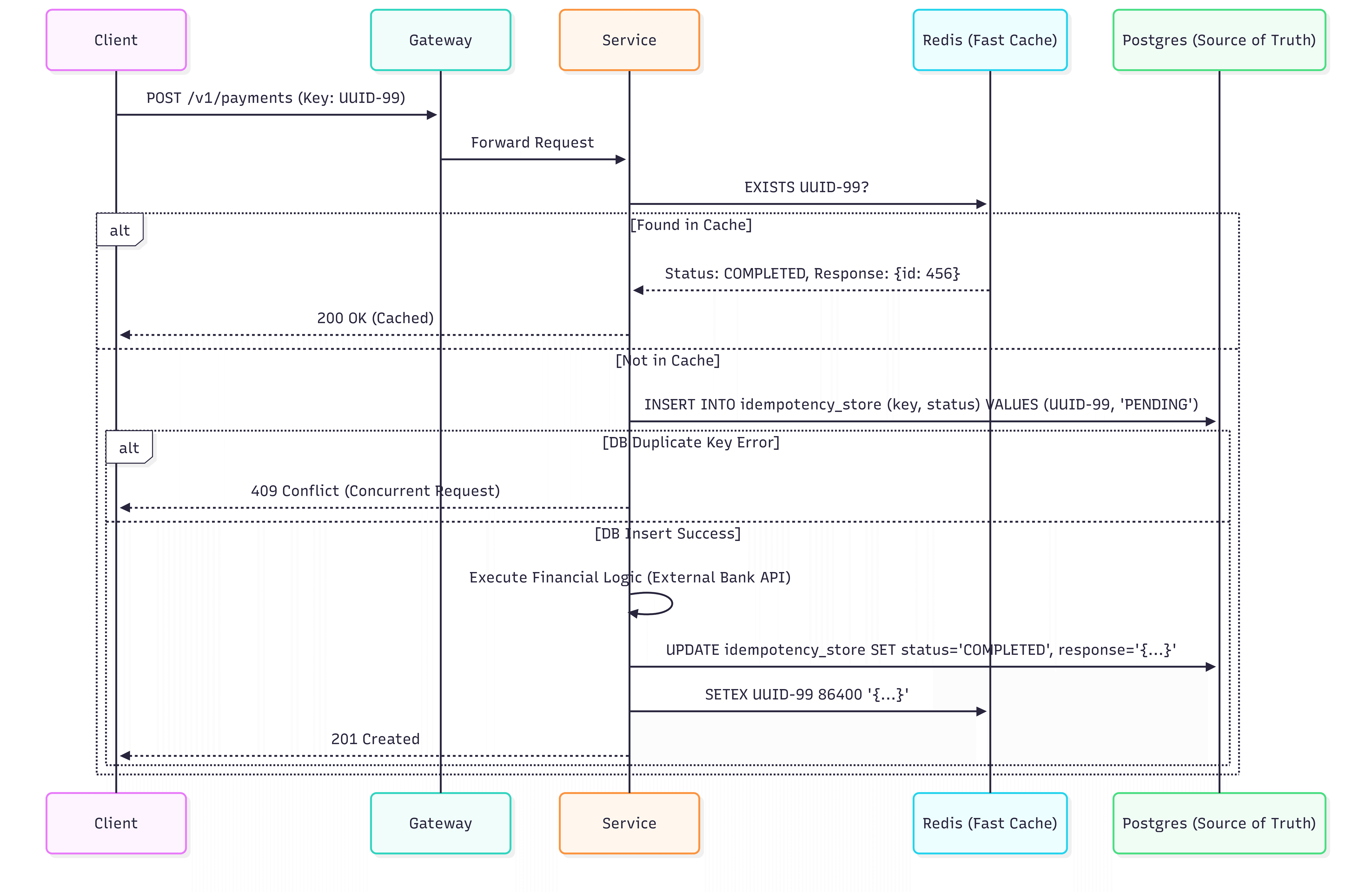
Diagram Flow Breakdown
Phase 1: The Fast Path (Redis Cache): Upon receiving a client request, the service first checks Redis for the idempotency key (e.g., EXISTS UUID-99?). If the key is found (already processed), the system immediately returns a 200 OK response without querying the database. This significantly reduces the read load on the primary database.
Phase 2: The Atomic Lock (Postgres): If the key is not found in the cache, the system executes an INSERT command in PostgreSQL with status='PENDING'. This deliberately leverages PostgreSQL's Unique Key Constraint as a deterministic lock. In financial systems, relying on a strict database-level constraint is far more secure and resilient than depending solely on a distributed in-memory lock.
Phase 3: Race Condition Handling (409 Conflict): This is a critical safeguard. If two identical requests arrive within milliseconds and both bypass the initial Redis check, PostgreSQL will only allow the first request to be inserted. The concurrent request will trigger a Database Duplicate Key Error, prompting the system to safely return an HTTP 409 Conflict (Concurrent Request). This mechanism completely prevents double-spending.
Phase 4: Execution & State Sync: Once the database insert is successful, the actual financial business logic (e.g., calling an External Bank API) is executed. Following this, the primary "Source of Truth" (PostgreSQL) is updated to COMPLETED. Finally, the Redis cache is updated with a TTL (e.g., SETEX for 86400 seconds / 24 hours) so that any future duplicate requests are swiftly handled at Phase 1.
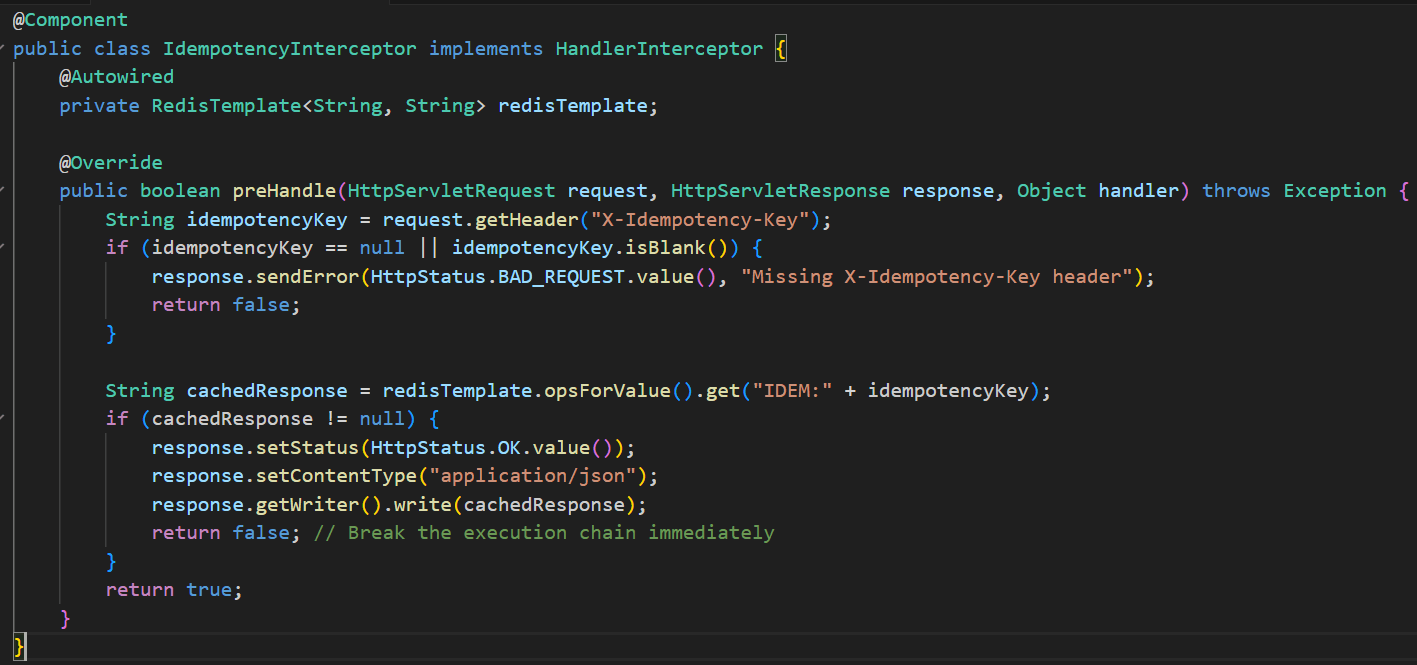
Code Snippet 1: Global Idempotency Filter (Java/Spring)
This interceptor ensures that no expensive business logic or external API calls are executed if a duplicate key is detected at the network's edge.
Edge-Level Idempotency Enforcement
The provided code snippet demonstrates an edge-level filtering mechanism using Spring Boot's OncePerRequestFilter. This acts as the first line of defense in our idempotency architecture—often referred to as the "Fast Path."
By intercepting incoming HTTP requests before they reach the controller or core business logic layers, the filter extracts the X-Idempotency-Key from the request headers and queries the high-speed Redis cache.
Key Technical Advantages:
-
Request Short-Circuiting: If a cache hit occurs (indicating the transaction has already been processed), the filter immediately writes the cachedResponse back to the client and skips the filterChain.doFilter() call. This halts further execution entirely.
-
Resource Preservation: By rejecting duplicate requests (e.g., a user repeatedly clicking a "Transfer Funds" button) at the network edge, the system prevents unnecessary database connections, CPU cycles, and redundant external bank API calls.
-
Sub-Millisecond Latency: Because Redis operates entirely in-memory, this validation adds virtually zero overhead to the API's response time, keeping the system highly responsive even under heavy load.
The "Ticket" Analogy Think of the X-Idempotency-Key as a unique digital ticket generated by the frontend app the moment a user clicks "Pay". The backend doesn't guess intentions; it just checks tickets.
-
Scenario A: The Accidental Retry (Network Drop) A user sends ₹1000, but the network fails. The app automatically retries in the background, handing the server the exact same ticket (Old Key). Backend reaction: "I've already stamped this ticket." It safely returns a success message without deducting the money again.
-
Scenario B: The Intentional Second Payment Ten minutes later, the user intentionally sends another ₹1000 to the same person. Because they clicked the button again, the app generates a brand-new ticket (New Key). Backend reaction: "This is a new ticket I haven't seen before." It processes the payment and deducts the funds.
The Bottom Line: The backend completely ignores the transaction details (like amount or payee) when checking for duplicates. The system identifies duplicate requests exclusively through the Idempotency Key. An identical key indicates a duplicate transaction, whereas a newly generated key initiates a fresh transaction.
3. Layer 2: Concurrency Control via Optimistic Locking
API keys stop external client retries, but they do not stop two different internal threads from modifying the exact same account balance simultaneously. In high-throughput ledger systems, using pessimistic locking (SELECT ... FOR UPDATE) causes severe database bottlenecks and deadlocks. Instead, we utilize Optimistic Locking to handle concurrency securely without sacrificing throughput.
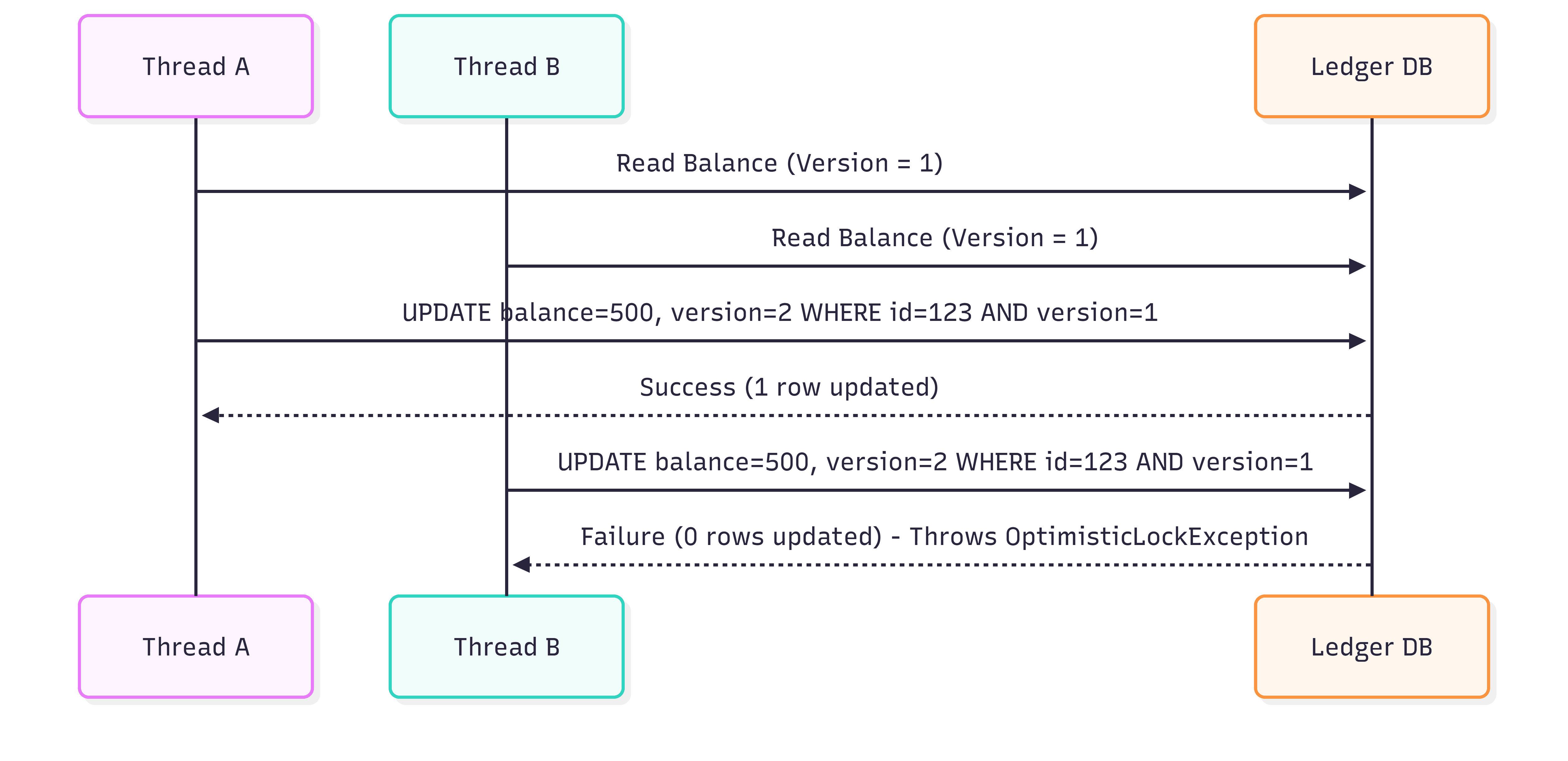
Diagram Flow Breakdown: Optimistic Locking in Action
-
Step 1: The Concurrent Read (The Race Begins): Both Thread A and Thread B attempt to modify the same account balance simultaneously. They both read the current state of the ledger row, and both observe that the record is at Version = 1.
-
Step 2: The Winning Thread (Thread A): Thread A fires its update query first. Crucially, the SQL statement includes a condition: WHERE id=123 AND version=1. Since the database row is indeed still at version 1, the update is successful. The database commits the new balance and automatically increments the row to Version = 2.
-
Step 3: The Version Mismatch (The Block): Microseconds later, Thread B fires its update query, also looking for WHERE id=123 AND version=1 (because that is the state it originally read). However, the database row is now at version 2. The database finds zero matching rows and rejects the update.
-
Step 4: Safe Failure (Exception Handling): Because 0 rows were updated, the backend framework (e.g., Hibernate/Spring Data JPA) instantly detects the anomaly and throws an OptimisticLockException. The system safely aborts Thread B's transaction, preventing a race condition that would have otherwise overwritten Thread A's balance update.
Why This is Essential for Fintech
You hit the nail on the head regarding Pessimistic Locking. If you used SELECT ... FOR UPDATE (Pessimistic Locking), Thread A would place a hard lock on the row, forcing Thread B to wait in a queue. In a system processing thousands of UPI transactions per second, this creates massive database bottlenecks, connection pool exhaustion, and potential deadlocks. Optimistic locking avoids database locks entirely, operating on the assumption that collisions are rare, thereby maximizing throughput.
Code Snippet 2: Versioned Entity for Financial Ledgers
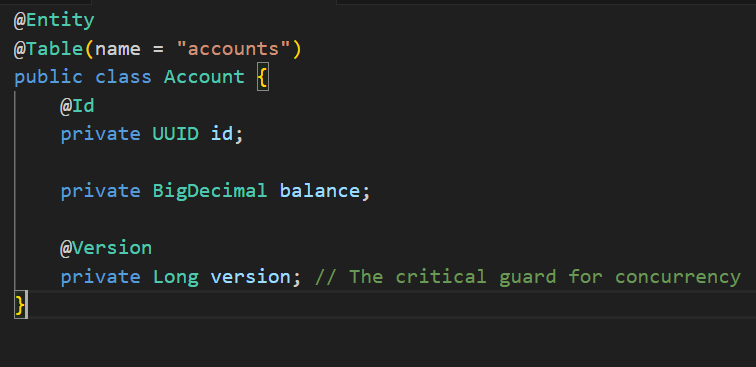
Code Snippet 2 demonstrates the foundational setup phase of Optimistic Concurrency Control at the data model level. By utilizing the @Version annotation provided by Spring Data JPA and Hibernate, we define the concurrency locking mechanism directly within our entity class, such as a financial Ledger or Account.
This declarative approach eliminates the need to manually write complex, raw SQL queries for row-level locking. It acts as the structural security system for the database table. When an application attempts to update the entity, the ORM framework automatically intercepts the transaction and appends a WHERE version = {current_version} condition to the underlying SQL UPDATE statement.
If the database update executes successfully, Hibernate automatically increments this version attribute by one. This passive, built-in mechanism ensures that the strict rules for data integrity are inherently tied to the entity itself, allowing high-throughput ledger systems to operate smoothly with absolutely zero pessimistic locking overhead.
Code Snippet 3: Handling Concurrency Conflicts
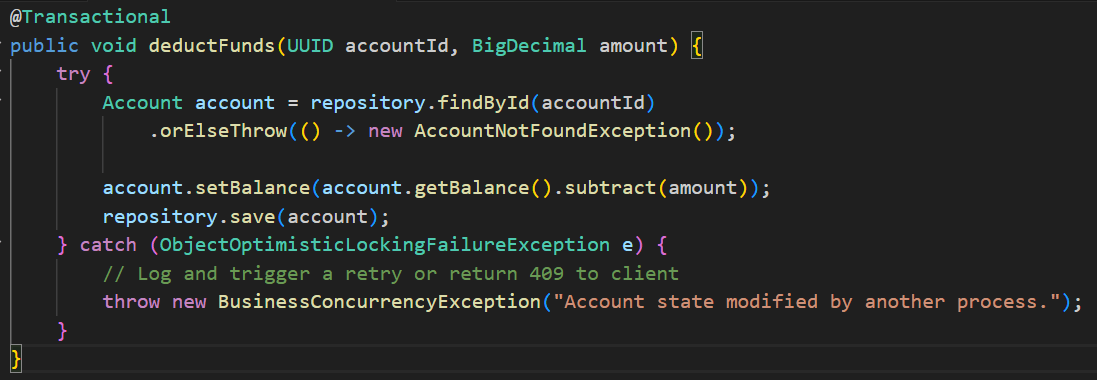
Code Snippet 3 illustrates the critical final step in an optimistic locking architecture: gracefully handling the inevitable collisions. When building robust financial systems, intercepting these exceptions prevents cascading failures and ensures total data integrity.
In this deductFunds method, the @Transactional annotation guarantees that the operation remains atomic. The sequence begins by fetching the account entity, which pulls the current balance and the associated version number into memory. After calculating the new balance, the application attempts to persist in the state using repository.save(account).
If another thread has modified this exact account record in the fraction of a millisecond between the read and write operations, the framework throws an ObjectOptimisticLockingFailureException. Catching this specific Spring Data JPA exception is incredibly crucial. Instead of allowing the application to crash or return an exposed database error directly to the client, the code intercepts the failure and wraps it inside a custom BusinessConcurrencyException.
This standard approach allows the outer layers of your architecture to react intelligently. The system can quickly return an HTTP 409 Conflict status to the front-end, clearly signaling the client application to refresh its state, or cleanly trigger an automated retry mechanism to successfully re-attempt the entire transaction using the newly updated ledger balance without any manual user intervention.
4. Layer 3: The Transactional Outbox Pattern
A common failure is updating the database but failing to send the "Payment Succeeded" event to Kafka. The Transactional Outbox pattern ensures these actions are atomic by saving the event into a local outbox table within the exact same database transaction. A background CDC process then forwards it.

Understanding the Transactional Outbox Flow
The provided architecture diagram illustrates how the Transactional Outbox pattern elegantly solves the dual-write problem by dividing the process into two distinct, decoupled phases: the synchronous Service Cluster and the asynchronous Reliability Pipeline.
Phase 1: The Service Cluster (The Atomic Commit) Instead of allowing the business logic to communicate directly with the message broker, all operations are confined to the local database to guarantee atomicity.
-
Step 1: Start Transaction: The application's business logic initiates a standard database transaction.
-
Step 2a & 2b: The Dual Write: Within this single transaction, the system performs two actions simultaneously. It modifies the core business state (2a. Update Balance in the Accounts Table) and inserts a corresponding event record (2b. Save Event in the Outbox Table).
-
Step 3: Commit: The database transaction is committed. If either the balance update or the event insertion fails, the entire transaction rolls back. This guarantees that an event is never published without a state change, and a state change never occurs without generating an event. Once committed, the user immediately receives a success response.
Phase 2: The Reliability Pipeline (Asynchronous Streaming) Once the transaction is safely committed, the message delivery is offloaded to a separate background process, completely removing network latency from the user's critical path.
-
Step 4: Poll/Stream: A Change Data Capture (CDC) tool, such as the Debezium Connector, continuously monitors the database's transaction logs (e.g., PostgreSQL's WAL or MySQL's binlog) for new entries in the Outbox Table.
-
Step 5: Guaranteed Delivery: Upon detecting a new outbox record, Debezium extracts the payload and reliably routes it to Apache Kafka. If the network drops or Kafka experiences downtime, Debezium simply pauses and retries later from its last recorded offset, providing a rock-solid guarantee that the event will eventually be delivered.
Code Snippet 4: Implementation of Outbox Pattern
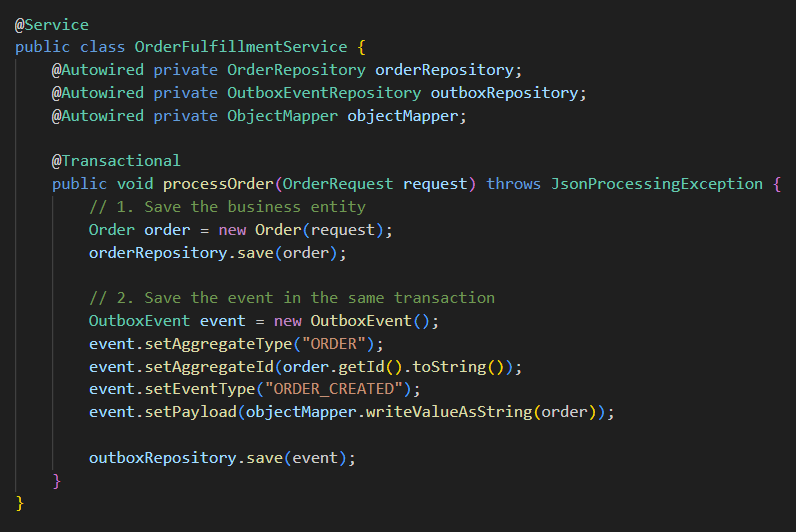
This code snippet demonstrates the practical implementation of the Transactional Outbox pattern at the application level using Spring Data JPA. The primary objective is to eliminate the "dual-write" problem by ensuring that modifying the core business state and dispatching the system event are executed as a single, atomic unit of work.
The foundation of this fail-safe mechanism is the @Transactional annotation. Within the service method, the application explicitly avoids making any direct network calls to a message broker. Instead, it executes two purely local database operations:
-
It updates or persists the primary business entity (such as saving a newly created Order or updating a financial ledger balance).
-
It immediately constructs an OutboxEvent object containing the event type and its JSON payload, saving it into a dedicated outbox repository.
Because both operations share the exact same database connection and transaction context, they are guaranteed to either commit simultaneously or roll back entirely. If a failure occurs before the commit, no partial state is saved. Once successfully committed, the application thread is freed immediately to ensure low-latency API responses. Subsequently, a background Change Data Capture (CDC) pipeline will autonomously read this newly inserted outbox record and reliably stream it to the message broker, ensuring guaranteed event delivery.
5. Layer 4: Kafka Exactly-Once Semantics (EOS)
For service-to-service communication, we enable Kafka's native transactions and idempotency. This allows the broker to use sequence numbers to automatically drop duplicate messages during network retries. Consequently, messages become "visible" to downstream consumers only after the producer's transaction is fully and successfully committed.
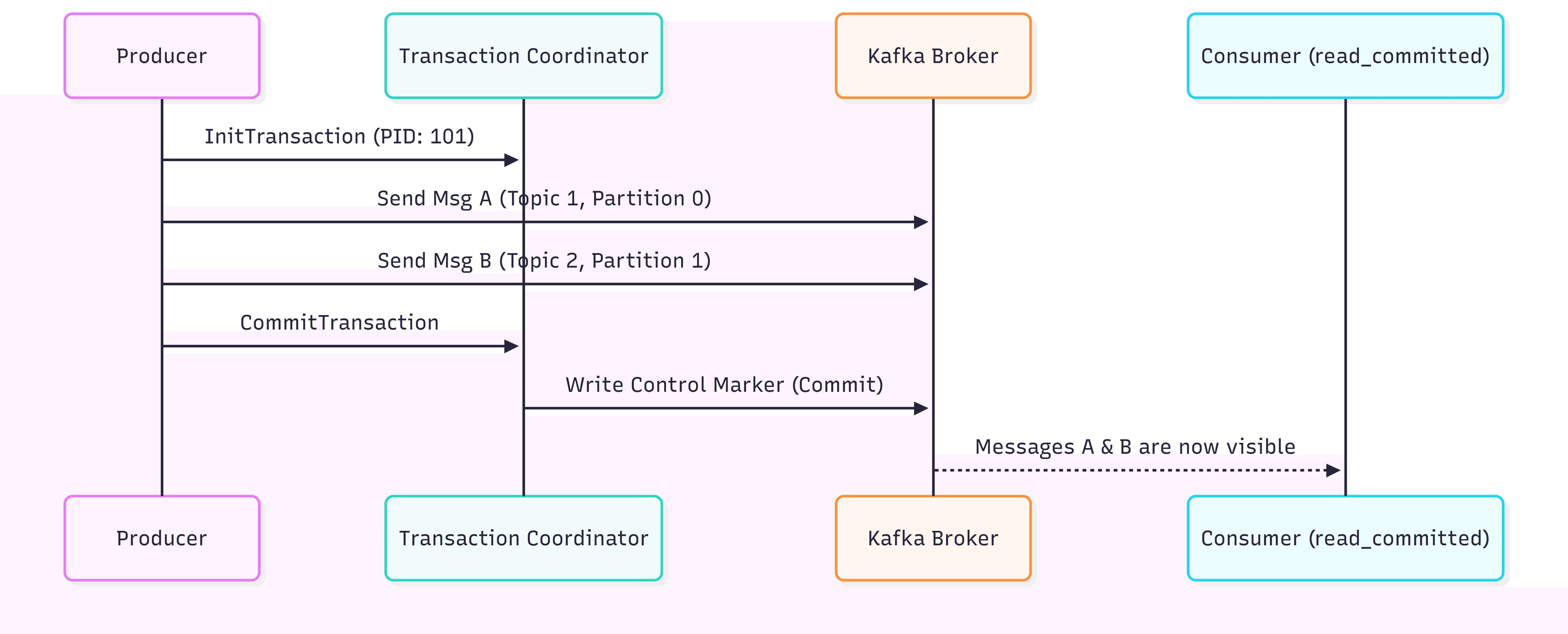
Diagram Flow Breakdown: Kafka Exactly-Once Semantics (EOS) in Action
Step 1: Transaction Initialization & The First Send (The Setup): The Producer App begins by initiating a transaction with the Kafka Cluster. It then publishes its data ("Message A") to the targeted Topic Partition. Under the hood, Kafka's idempotent producer automatically attaches a Producer ID (PID) and a unique Sequence Number (Seq 1) to this message.
Step 2: The Network Hiccup & Retry (The Phantom Duplicate): Due to a momentary network glitch or an acknowledgment timeout, the Producer App incorrectly assumes the message was lost in transit. To ensure data delivery, the Producer automatically retries, sending the exact same "Message A" again. Crucially, this retry carries the identical sequence number (Seq 1).
Step 3: Broker-Level Idempotency (The Drop): The Kafka Broker receives the retried message and inspects its metadata. It compares the incoming (Seq 1) against the highest sequence number it has already successfully appended for that specific producer. Recognizing the duplicate sequence, the broker intelligently drops the redundant message at the cluster level, completely preventing a double-write to the Topic Partition.
Step 4: The Commit & Isolation Level (The Reveal): Once the Producer has finished sending all messages for that business operation, it issues a Commit Transaction request, which is recorded in the internal Transaction Log. Meanwhile, the downstream Consumer App is configured with an isolation level of read_committed. Because of this strict isolation, the consumer is blocked from reading uncommitted data (the messages remain "Hidden"). Only after the Producer's transaction is fully and successfully committed do the deduplicated messages become "Visible" and available for the Consumer to process—guaranteeing Exactly-Once Processing across the microservices.
Code Snippet 5: Transactional Kafka Producer Config
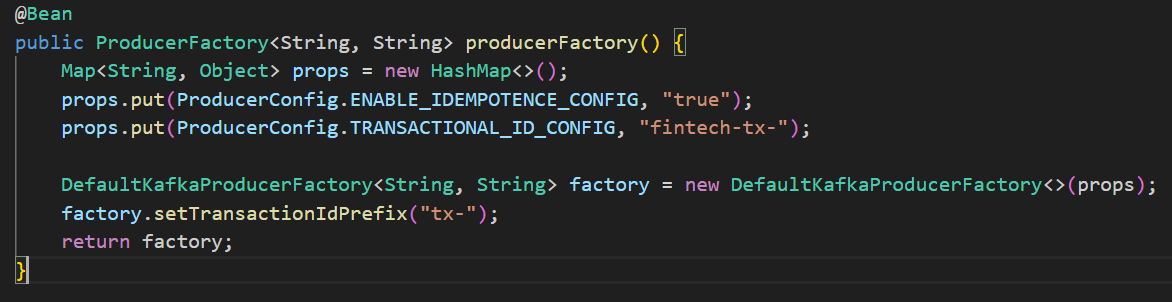
This Spring Boot configuration is the cornerstone for enabling Exactly-Once Semantics (EOS) at the producer level.
The implementation relies on two pivotal properties:
1. ENABLE_IDEMPOTENCE_CONFIG: Setting this to true forces the producer to assign a unique Producer ID (PID) and sequence number to every message. This empowers the Kafka broker to silently detect and drop duplicate messages caused by network retries.
2. TRANSACTIONAL_ID_CONFIG: By defining a transactional prefix (e.g., "fintech-tx-"), the producer can write to multiple Kafka topics atomically.
Combined, this factory ensures that even in the event of a crash, message production is treated as a single, indivisible transaction, perfectly aligning with the stringent integrity requirements of financial ledgers.
6. Distributed Transactions: The Saga Pattern
In traditional monolithic applications, a single database effortlessly guarantees ACID properties. However, as systems evolve into distributed microservices with "database-per-service" architectures, a single business flow often spans multiple independent databases—such as deducting funds from a Wallet Service and crediting a Ledger Service.
Because we cannot use a single @Transactional annotation across two different microservices, we face a critical challenge. Older protocols like Two-Phase Commit (2PC) attempt to solve this but introduce severe performance bottlenecks and database locking, which are unacceptable in high-throughput fintech systems. To achieve distributed data consistency without compromising system speed, we implement the Saga Orchestrator pattern.
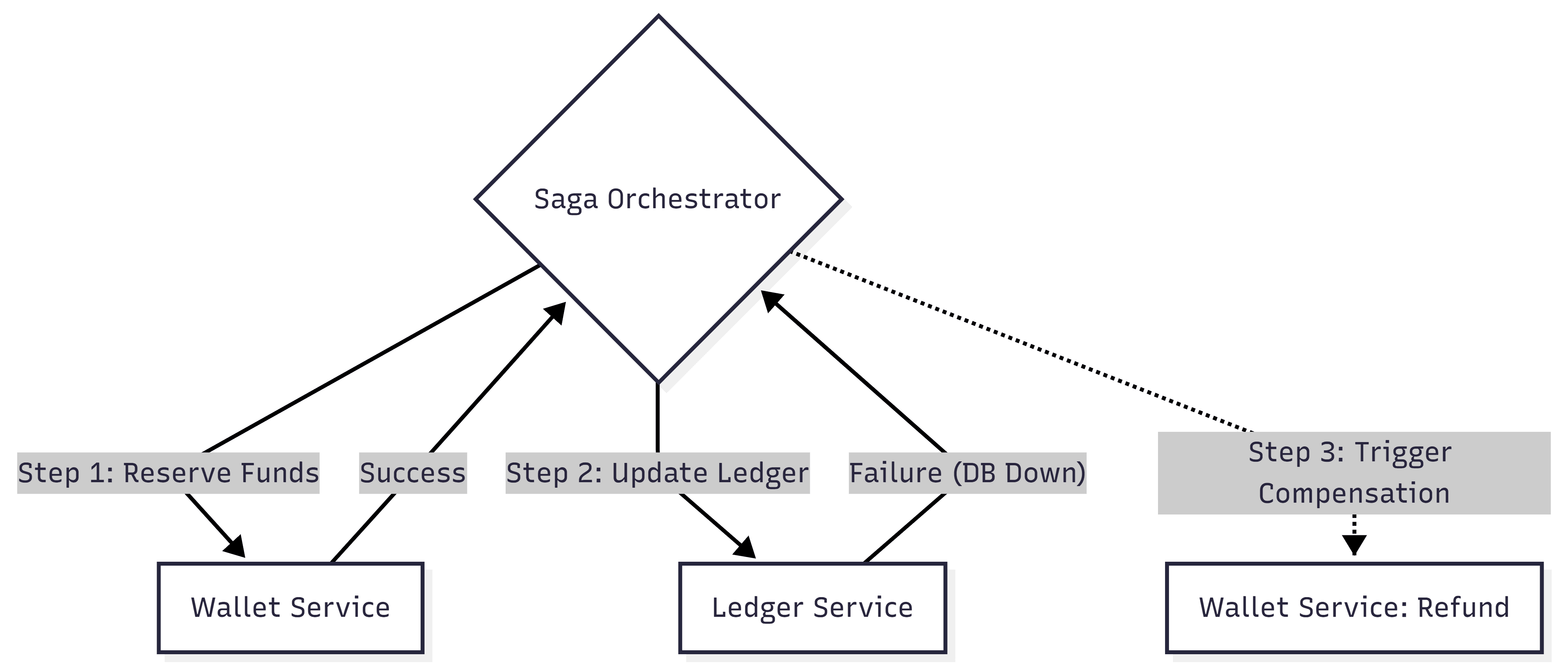
Understanding the Saga Orchestration Flow
The diagram illustrates a practical scenario of a distributed transaction managed by a Saga Orchestrator, specifically highlighting how system failures are handled gracefully without distributed locks. The process unfolds in three key steps:
1. The Initial Command (Success): The Orchestrator initiates the workflow by sending a "Debit" command to the Wallet Service. The Wallet Service successfully deducts the funds and acknowledges the operation.
2. The Downstream Failure: Moving to the next step, the Orchestrator sends a "Record" command to the Ledger Service. However, this operation fails due to an internal Database Error.
3. The Compensating Transaction (Rollback): Because traditional SQL rollbacks do not work across independent microservices, the system is temporarily in an inconsistent state (funds debited but not recorded). To fix this, the Orchestrator catches the failure and automatically issues a Compensating Command (represented by the dotted line). It tells the Wallet Service to "Credit" the exact amount back to the user, effectively "undoing" the first step and safely restoring the system to its original state.
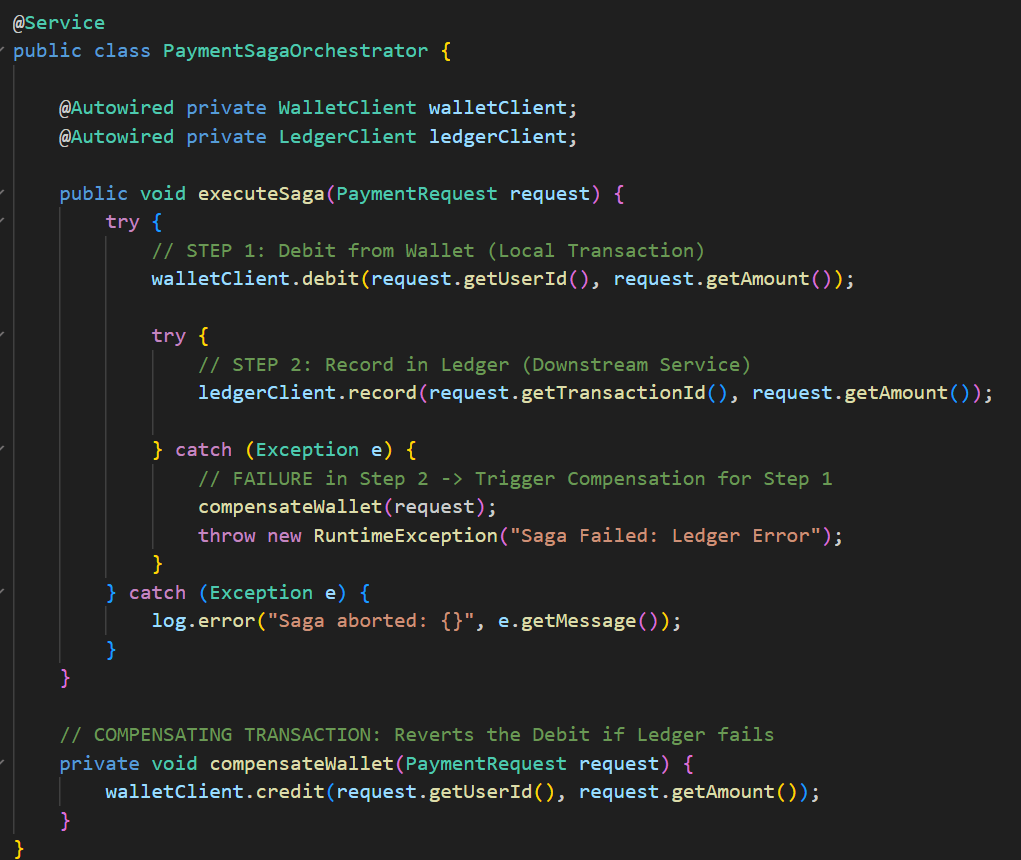
Code Snippet 6: Saga Orchestration Logic (Java)
To maintain data consistency across distributed microservices, we implement an Orchestrator-based Saga. This Java service manages the workflow and triggers compensating actions if any step in the chain fails.
The implementation follows a strict "success-or-compensate" logic:
1. Forward Flow: The Orchestrator initiates the sequence by calling the walletClient.debit(). This is a local transaction within the Wallet Service. Upon a successful response, it proceeds to the next step—calling the ledgerClient.record() to finalize the entry.
2. Failure & Compensation: If the Ledger Service call fails (e.g., due to a Database Error as shown in the diagram), the inner catch block intercepts the exception. It immediately triggers the compensateWallet() method.
3. The "Undo" Mechanism: The compensation method issues a reverse "Credit" command to the Wallet Service, restoring the user's funds. This programmatic coordination ensures that the system eventually returns to a consistent state, preventing "orphaned" transactions where funds are debited but never recorded.
7. Production Deployment Checklist
Before pushing exactly-once distributed architectures to production, ensure the following safety nets are active:
-
Database Integrity: Verify strict UNIQUE constraints on the idempotency_key columns across all relevant tables to block duplicate concurrent inserts at the database level.
-
Redis Persistence: Configure Redis with Append Only File (AOF) mode (appendonly yes) to prevent the loss of recent idempotency keys during sudden cache crashes.
-
Kafka Isolation: Ensure all downstream Kafka consumers are strictly configured with isolation.level=read_committed to avoid reading dirty, uncommitted transactional messages.
-
CDC Health Monitoring: Set up aggressive alerting for Debezium/Kafka Connect lag. If the connector fails, the outbox table will bloat, and downstream services will stall.
-
Saga Safety Nets (DLQ): Implement Dead Letter Queues (DLQ) and monitoring for failed compensating transactions. If a "Refund" or "Rollback" command repeatedly fails, it requires immediate manual/operational intervention.
-
Data Cleanup Strategy: Deploy an automated background job to purge processed records from the outbox table and the idempotency_store after a safe retention period (e.g., 7 days) to maintain query performance.
-
Concurrency Observability: Actively monitor OptimisticLockException rates. Sudden spikes in this metric indicate high account contention (database hotspots) that may require API throttling.
8. Common Pitfalls and Solutions
Even with robust architectural patterns, implementation flaws can compromise exactly-once guarantees. Here are three common pitfalls to avoid:
1. Pitfall: The Client Generates a New Key on Retry
-
The Issue: When a network timeout occurs, poorly designed frontend clients often generate a brand-new Idempotency-Key (UUID) for the retry attempt. The backend sees this as a completely new request, bypassing the idempotency check entirely and resulting in a disastrous double-spend.
-
The Solution: Educate frontend and API consumer teams that the Idempotency-Key is strictly tied to the business intent (e.g., "Pay Invoice #12345"), not the individual HTTP request. The client must persist in the original key locally and reuse it for all subsequent retries of that specific transaction.
2. Pitfall: In-Memory Idempotency State
-
The Issue: Developers sometimes store processed keys in local application memory (e.g., using a ConcurrentHashMap in Java). In a modern, containerized Kubernetes environment, the initial request might hit Pod A, while the retry hits Pod B. Pod B has no knowledge of Pod A's local memory, leading to duplicate processing.
-
The Solution: Never store critical idempotency state in local application memory. Always rely on a centralized, distributed data store—such as a highly available Redis cluster for the fast path, backed by the primary database for persistent locking.
3. Pitfall: Over-reliance on Two-Phase Commit (2PC)
-
The Issue: Traditional 2PC protocols lock database resources across multiple microservices until the entire global transaction is fully complete. In a high-throughput financial system, this synchronous locking causes severe latency bottlenecks and single points of failure.
-
The Solution: Replace 2PC with Saga Orchestration for cross-service workflows. Instead of global locks, break the transaction into a sequence of isolated, local database commits. If a downstream step fails, the Orchestrator safely triggers automated compensating transactions (e.g., a refund) to restore system consistency.
9. Conclusion
Exactly-Once Processing is not a feature you simply turn on; it is a strict architectural commitment. By purposefully combining API-level idempotency, the Transactional Outbox pattern, and Kafka's native transactions, we create a system that is inherently resilient to the unavoidable "unknowns" of distributed networking.
When navigating the complexities of high-throughput financial systems, mastering these core patterns is the only reliable way to achieve true peace of mind—knowing that no matter how unpredictably the network behaves, the ledgers will always balance perfectly.
10. References
[1] Kleppmann, M. (2017). Designing Data-Intensive Applications. O'Reilly Media.
[2] Richardson, C. (2018). Microservices Patterns. Manning Publications.
[3] Apache Kafka Documentation. (2025). Exactly-Once Semantics.
[4] Debezium.io. (2024). Reliable Data Exchange with the Outbox Pattern.
[5] Newman, S. (2015). Building Microservices. O'Reilly Media.
About the Author

Mayank Namdev
Mayank is a Project Lead with deep Java roots, known for untangling complex specifications and delivering clean, executable software solutions.
About the Author
Mayank Namdev
Mayank is a Project Lead with deep Java roots, known for untangling complex specifications and delivering clean, executable software solutions.